Cover image
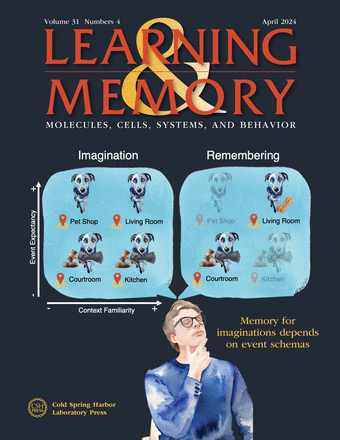
The ability to imagine events is critical for several future-oriented behaviors, ranging from planning and problem solving to creative and divergent thinking. However, for our imaginations to be useful for these behaviors in the future, they must be remembered. In this issue of Learning & Memory, Fenerci, Adjei, and Sheldon (LearnMem a053993.124) examined the role of event schemas (i.e., knowledge structures capturing how events typically unfold) in determining the memorability of our imaginations. They show a complementary benefit to remembering schematic and novel imagined events. The cover illustration represents events imagined with various associations to extant event schemas (left panel). Memory is enhanced for maximally congruent (e.g., playing with one's dog in the living room) and maximally incongruent (e.g., playing with one's dog in the courtroom) imaginations. As well, maximally congruent imaginations are remembered with newly added details, not originally part of the imagination (i.e., toy bone). (Cover art designed and created by Can Fenerci.)