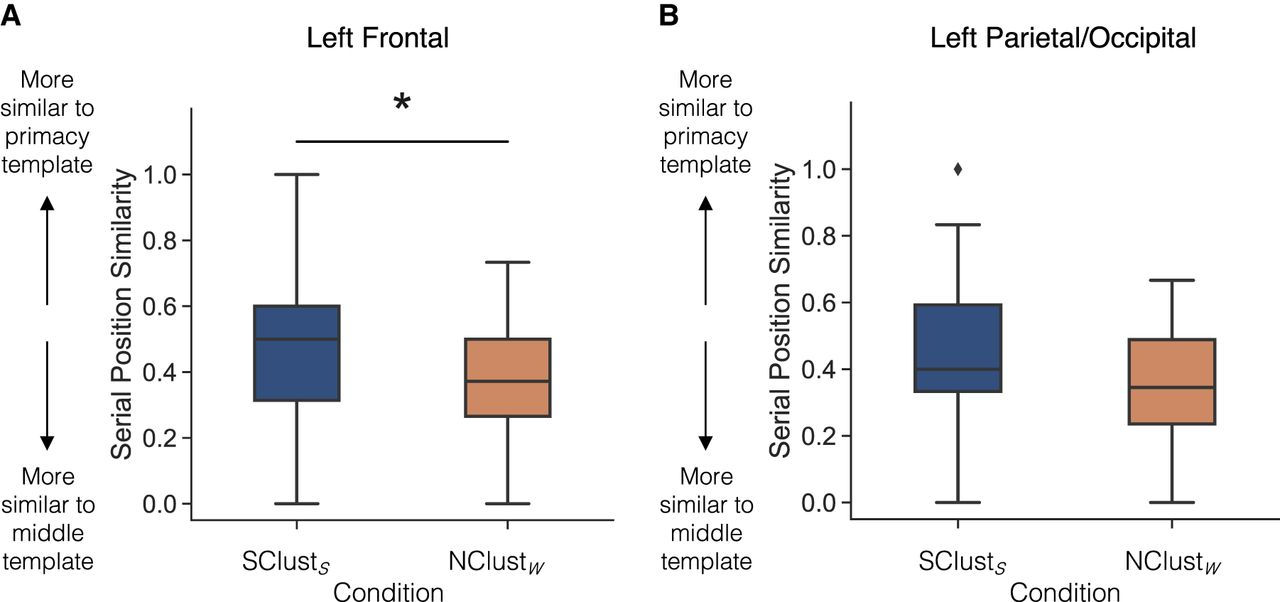
Template similarity analysis for second associates. We generated two templates, one for primacy items (serial positions 1–4) and one for middle items (serial positions 5–8) across all participants. Templates were based on zPower across 46 frequencies and seven electrodes from either the left frontal ROI (A) or the left parietal/occipital ROI (B). We correlated each second associate with each template. A trial was labeled “1” if it correlated more strongly with the primacy template and “0” if it correlated more strongly with the middle template. The boxes denote interquartile range, the whiskers denote minimum and maximum values. (A) The template includes left frontal electrodes. We find that SClusts second associates are significantly more likely to be assigned a “1” or primacy label compared to NClustw second associates (P = 0.017). (B) The template includes left parietal/occipital electrodes. We find that SClusts second associates are numerically more likely to be assigned a “1” or primacy label compared to NClustw second associates (P = 0.116).