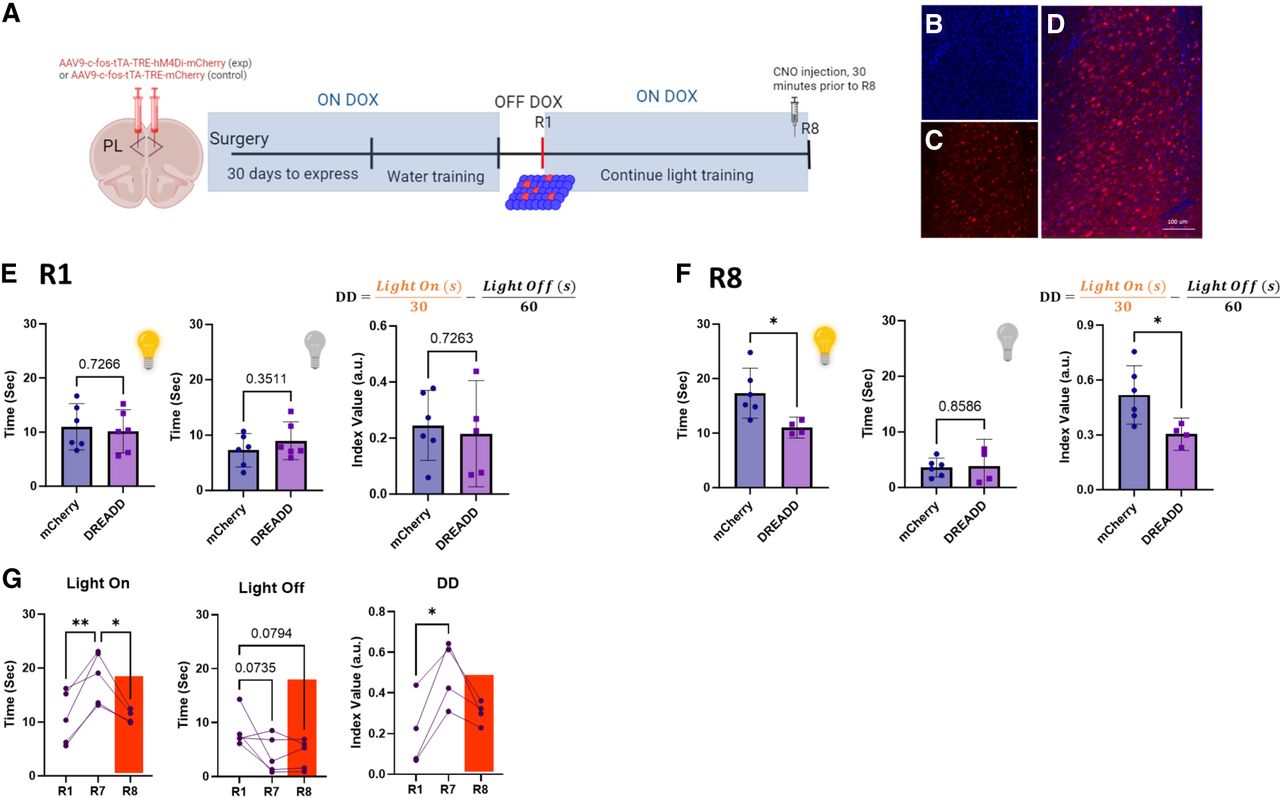
Chemogenetic inactivation during the late stages of learning of PL cortex cells required for early learning decreases cue-driven behavior. (A) Mice were injected at previously detailed PL coordinates with either an engram-specific hM4Di DREADD (n = 5) or a cFos-tTa-mCherry control (n = 6). The population of cells active during the first exposure to associative learning will be chemogenetically inhibited during late learning to determine whether that population of cells required for early learning is necessary for association-driven behavior or if there are neural mechanisms that compensate for the loss of those cells. Representative images of the PL are shown in B–D. (B) Nuclear marker, DAPI. (C) cFos-tTa-TRE-hM4Di-mCherry labeled cells, tagged during R1 and inhibited in R8. (D) Merge. (E) There is no significant difference between the behavior of the control and experimental groups during R1 (Light on: t10 = 0.3596, P = 0.7266) (Light off: t10 = 0.9760, P = 0.3511) (DD: t9 = 0.3611, P = 0.7263), suggesting that a similar population of cells will be tagged for later deactivation. (F) With engram-specific PL inhibition occurring in late learning, a deficit is seen during the light-on paradigm (t8 = 2.753, P = 0.0250). Namely, the DREADD group exhibits a deficit in reward-seeking behavior during periods of cue availability that are not seen when the light is turned off (t8 = 0.1840, P = 0.8586), but are reflected in a significant decrease of the DD (t8 = 2.664, P = 0.0286). (G) This panel of three graphs compares behavior exhibited during R1, R7, and R8 for the experimental DREADD group to show that learning proceeded normally until inactivation took place, at which point all subjects exhibited an impairment of poking behavior during periods of cue availability. These differences are not enough to create a significant impairment of the DD. Red bars represent the day of inactivation.