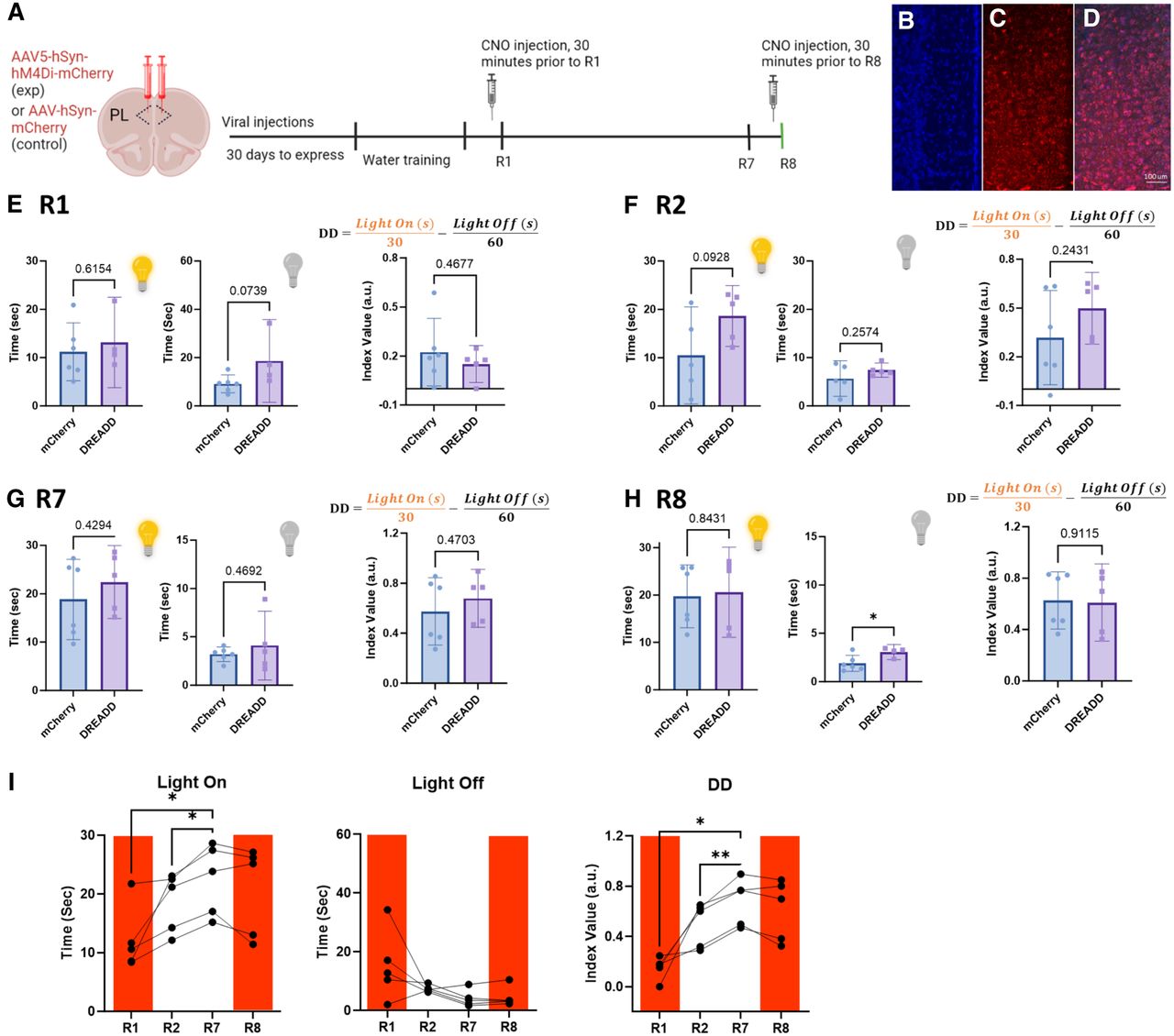
Chemogenetic inactivation of the PL cortex during late stages of learning, but not early stages, disrupts association-driven behavior. (A) Experimental groups (n = 5) were injected with an inhibitory DREADD virus while control groups received mCherry vector instead (n = 6). The virus was given 30 d to express before the start of water training. Mice went through the standard 3 d of water training. Half an hour prior to the beginning of light training (R1), mice were intraperitoneally injected with clozapine-N-oxide (CNO) to chemogenetically inactivate the PL for the duration of the task. After R1, mice continued to train for the remainder of the task. Unlike previous experiments, there was another day (R8) run, before which the mice received another CNO injection to inactivate the PL once more. Representative images of the PL are shown in B–D. (B) Nuclear marker, DAPI. (C) hSyn-hM4Di-mCherry labeled cells during peak expression. (D) Merge. (E) With the PL being chemogenetically inhibited during encoding, behavioral results from R1 show that DREADD mice do not exhibit any changes in reward-seeking behavior during the light-on (t8 = 0.5225, P = 0.6154) or light-off (t8 = 2.055, P = 0.0739), which is reflected in the DD between the two groups not varying significantly (t9 = 0.7583, P = 0.4677). (F) The day of learning following PL inhibition, the experimental and control groups of mice do not appear to vary significantly during either light-on (t8 = 1.908, P = 0.0928), light-off (t8 = 1.220, P = 0.2574), or in their DD (t9 = 1.249, P = 0.2431). (G) Following 6 d of unperturbed learning, behavioral outputs on R7 show that DREADD mice exhibited a normalization of behavior, as all behavioral outputs were not statistically different from controls (Light-on: t9 = 0.8275, P = 0.4294) (Light-off: t9 = 0.7555, P = 0.4692) (DD: t9 = 0.7537, P = 0.4703). (H) Upon performing another round of PL inhibition during remote recall, DREADD mice exhibited a significant increase in poking during the light-off period (t8 = 2.600, P = 0.0316) without a change in light-on behavior (t9 = 0.2038, P = 0.8431). This change in poking during the light-off was also not big enough to significantly affect the DD (t9 = 0.1144, P = 0.9115). (I) Looking longitudinally across days of behavior for the experimental group, there is no significant change in any metric of behavior between R7 and R8 associated with the DREADD inactivation of PL cells. Red bars represent the day of inactivation.