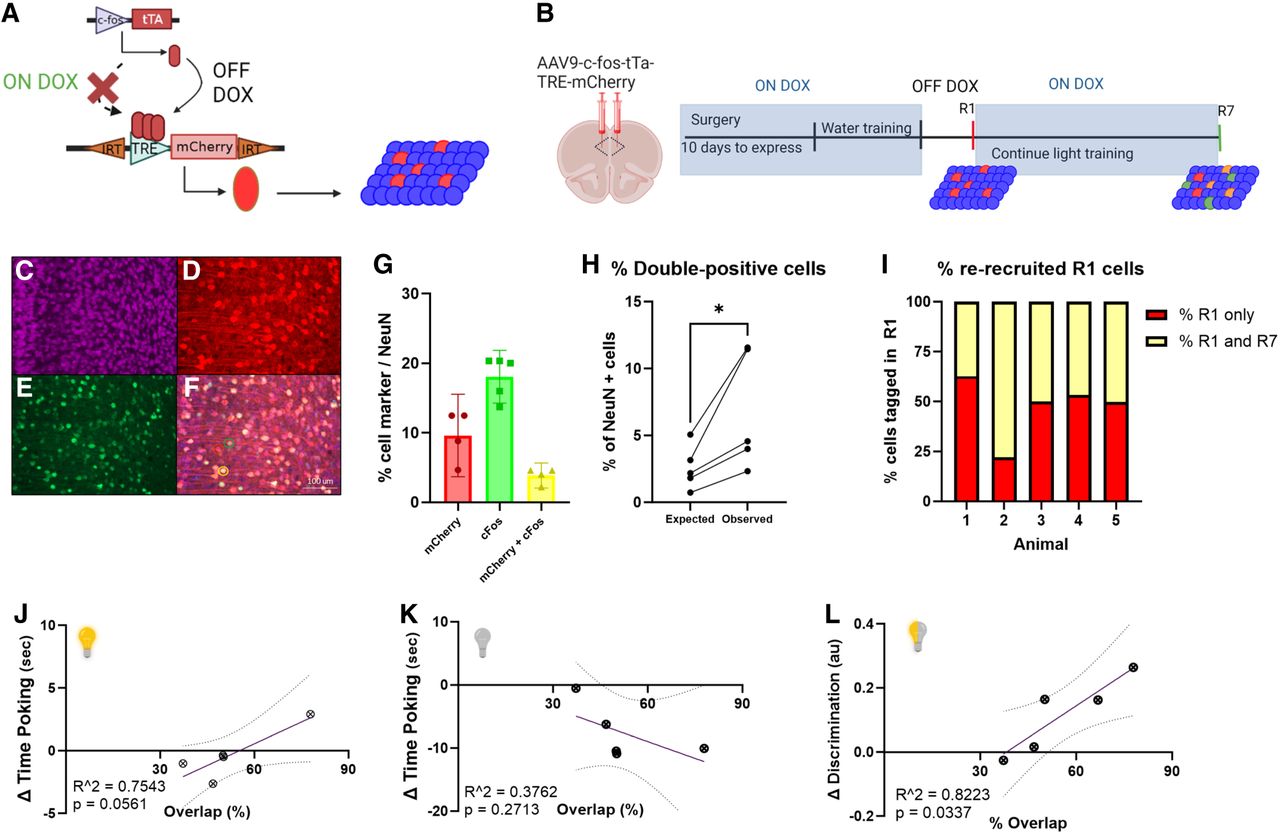
Characterizing the consolidation of PL engram cells. (A) A pictorial representation of the tet-Tag system, which is used to create an activity-dependent tag of an experience. (B) Mice (n = 5) were taken off Dox at the end of water training, 24 h before R1. Encoding of the association (R1) was tagged, and mice were immediately placed back on Dox to close the tagging window. Animals continued light training and were time perfused immediately after R7 to get the endogenous cFos pattern of late learning. Representative images of the PL are shown in C–F. (C) Nuclear marker, NeuN. (D) cFos-tTa-TRE-mCherry labeled cells activated during R1. (E) c-Fos labeled cells activated during R7. (F) Merge of all channels. The red circle identifies a cell with only a mCherry tag, the green circle indicates only a cFos tag, and the yellow circle indicates a cell with both the mCherry and cFos tags. (G) Percentage of mCherry-positive, cFos-positive, and double-positive cells from total cells (NeuN+). (H) The percent of observed double-tagged cells is compared to chance, calculated using the formula (# mCherry-positive cells/# NeuN-tagged cells) * (# cFos-positive cells/# NeuN-tagged cells). There is a significant difference between the two, indicating that there is more overlap than if the two populations were independent (t4 = 3.111, P = 0.0358). (I) This stacked bar chart represents the percentage of reactivated cells. The proportion of cells that were activated in both R1 and R7 are shown in yellow, expressed as a percentage of the R1 tag. The remaining cells, representing the cells that were only active during R1 and were not brought back online for R7, are shown in red. (J–L) The change in behavior from early to late learning was quantified and linear regressions were performed. The change in time spent poking for sucrose water during the light-on paradigm was marginally correlated with percentage of overlapping cells and strongly correlated with DD. There was an insignificant association between the % overlapping cells and change in light-off behavior.