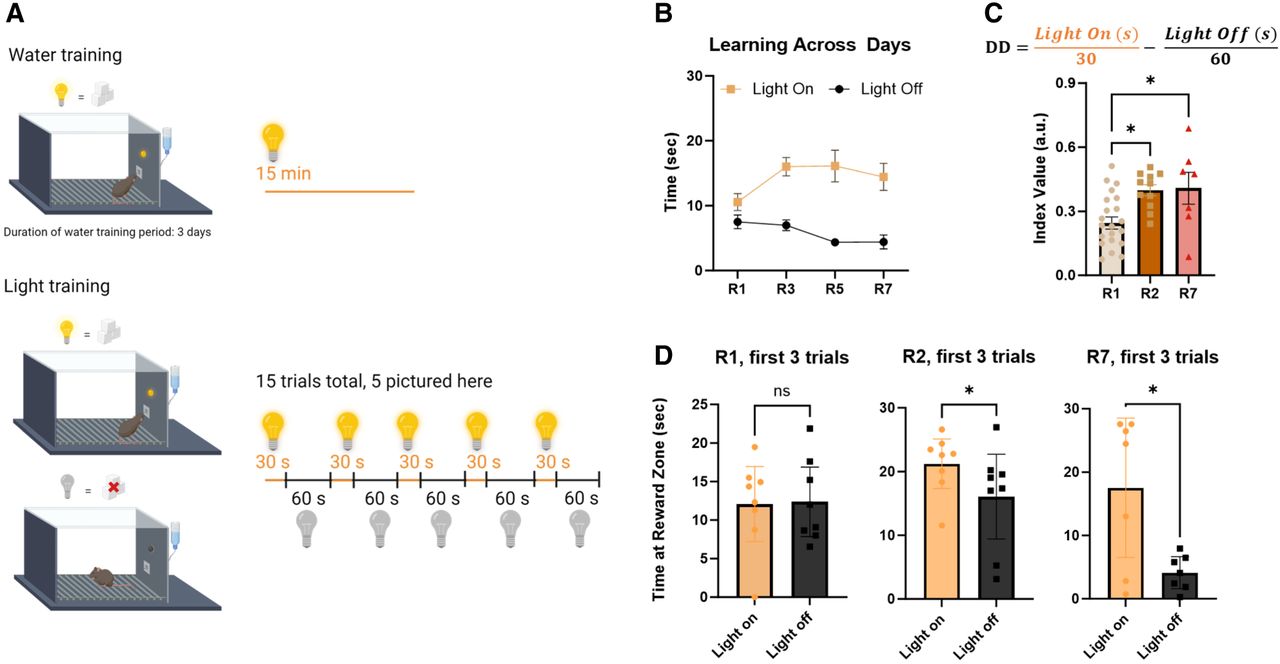
Mice learn to associate light with reward availability across two stages of training. (A) The behavioral paradigm was split into two periods. In the water training paradigm, the light was continuously turned on for the 30-min duration of the trial and mice could freely poke for sucrose water. The light training paradigm featured 15 alternating light-on/light-off trials, with sucrose water only available during the light-on interval. (B) Time spent poking for sucrose water during light-on and light-off periods on days 1, 3, 5, and 7 of light training (marked R1, R3, R5, and R7, respectively) shows an increase of time spent at the nose port during the light-on epoch and decreased time spent during the light-off epoch across days. A two-way mixed ANOVA was run to examine the impact of light (Light On vs Light Off) and time (R1 through R7) on poking behavior. There was a significant main effect of light, F(1,46) = 69.34, P < 0.0001, indicating that the presence of the cue drives poking during the Light On conditions. There was no significant main effect of day on the behavior, F(3,46) = 1.206, P = 0.3181, but there was a significant interaction effect of the two (F(3,46) = 3.466, P = 0.0236), indicating that the change in behavior is due to an interaction between both the day and the cue condition. (C) The discrimination difference (DD) was calculated to show the proportion of time spent at the water port during the light-on versus light-off period using the formula: (Poking during Light On [sec]/30) − (Poking during Light Off [sec]/60). Significant main effects were found for Day, indicating that mice were able to learn the meaning of the light and associate it with reward after going through training (F(2,37) = 6.627, P = 0.0035, R2 = 0.2637). (D) To further decipher whether or not light became associated with reward, the results of just the first three light-on and light-off periods were compared during R1, R2, and R7. Together, this shows that recognition for the light's significance was not present on day 1 of training (t7 = 0.1931, P = 0.852). By day 2 of training, significantly more time was spent at the nose port with the light present (t7 = 2.536, P = 0.039), indicating the learning of its significance. By day 7, there is an increasingly marked difference between time spent at the nose port between the light-on and light-off periods (t6 = 3.363, P = 0.0152). The increased variability of light-on behavior may be a side effect of habituation, as the mice receive a consistently large number of trials and may prefer to space out poking for sucrose water across more trials, no longer sensing the urgency in obtaining reward as quickly as possible.