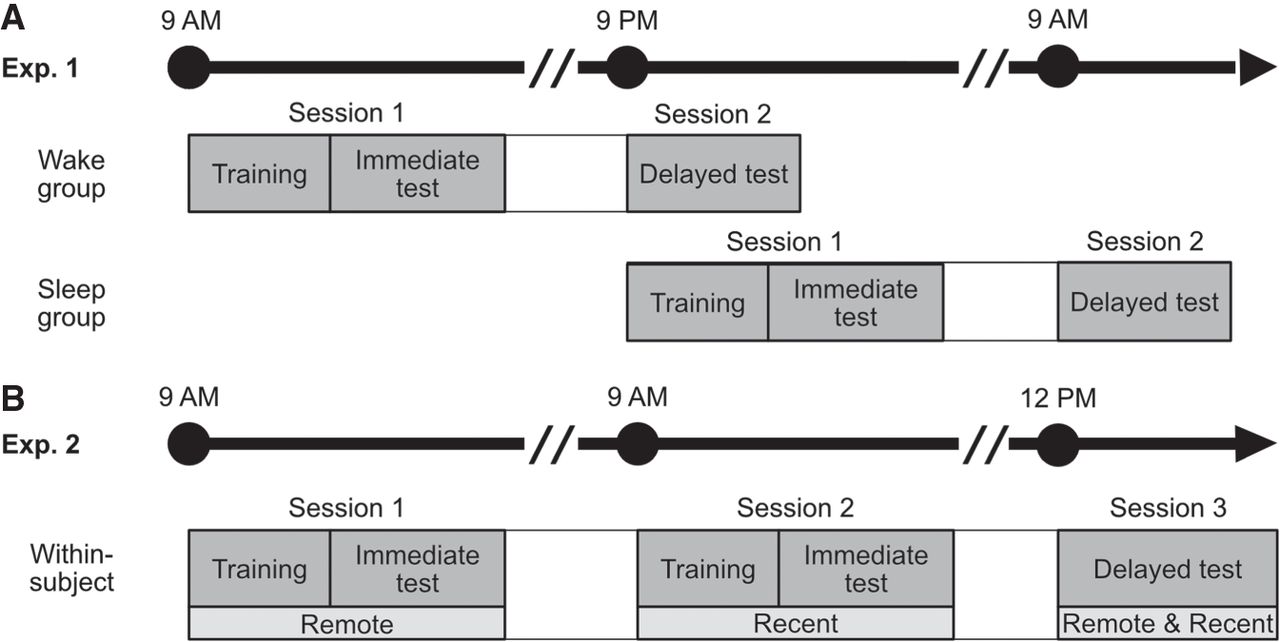
Experimental procedure. (A) Experiment 1. Participants were randomly assigned to either the wake group or the sleep group. The wake group started the experiment at 9:00 a.m. (±30 min), and the sleep group started the experiment at 9:00 p.m. (±30 min). Both groups followed the same procedure. In session 1, participants learned three separate hierarchies to criterion (premise pairs only). Immediately after training, participants were tested on all three hierarchies (premise pairs only). In session 2, 12 h later, participants were tested again on all three hierarchies, as well as on the novel inference pairs. (B) Experiment 2. All participants started between 9:00 a.m. and 11:00 a.m. In session 1, participants learned one hierarchy (remote; premise pairs only). Immediately after training, they were tested on these premise pairs. In session 2, 24 h later, participants learned a second hierarchy (recent; premise pairs only). Immediately after training, they were tested on these new premise pairs. In session 3, 3 h later, participants were tested again, this time on premise pairs from both remote and recent hierarchies, as well as their respective novel inference pairs.