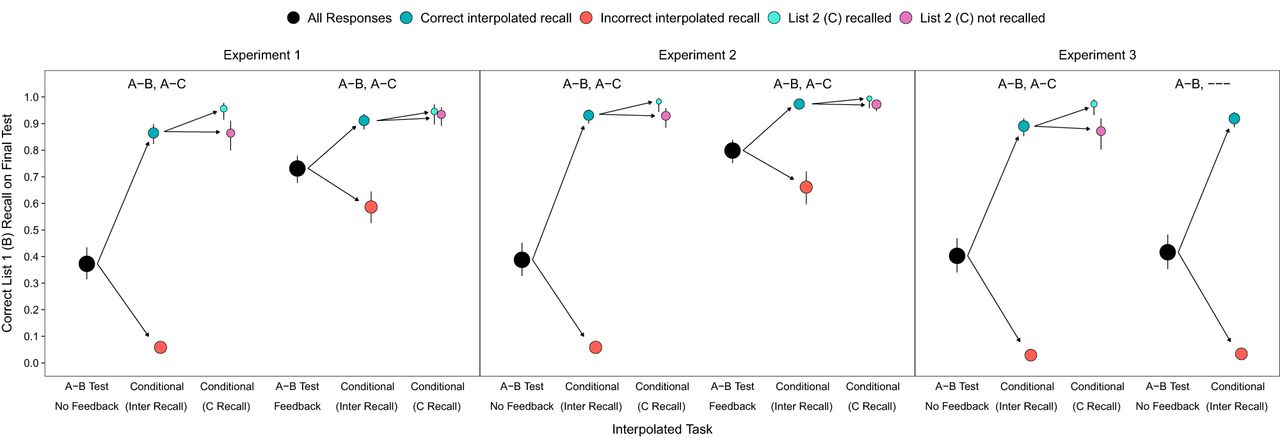
Final test list 1 recall, conditioned on recall in the interpolated phase and list 2. The interpolated task labels on the X-axis of each panel indicate what happened with A–B pairs in the interpolated phase before participants learned A–C pairs in list 2. The probabilities for “conditional” items were conditioned on whether the B response was recalled during the interpolated phase (interrecall) and whether the C response was recalled correctly (C recall) following correct interpolated B response recall. The point heights are the marginal means estimated from mixed-effect models, and error bars are 95% confidence intervals. The conditional point sizes indicate observation differences.