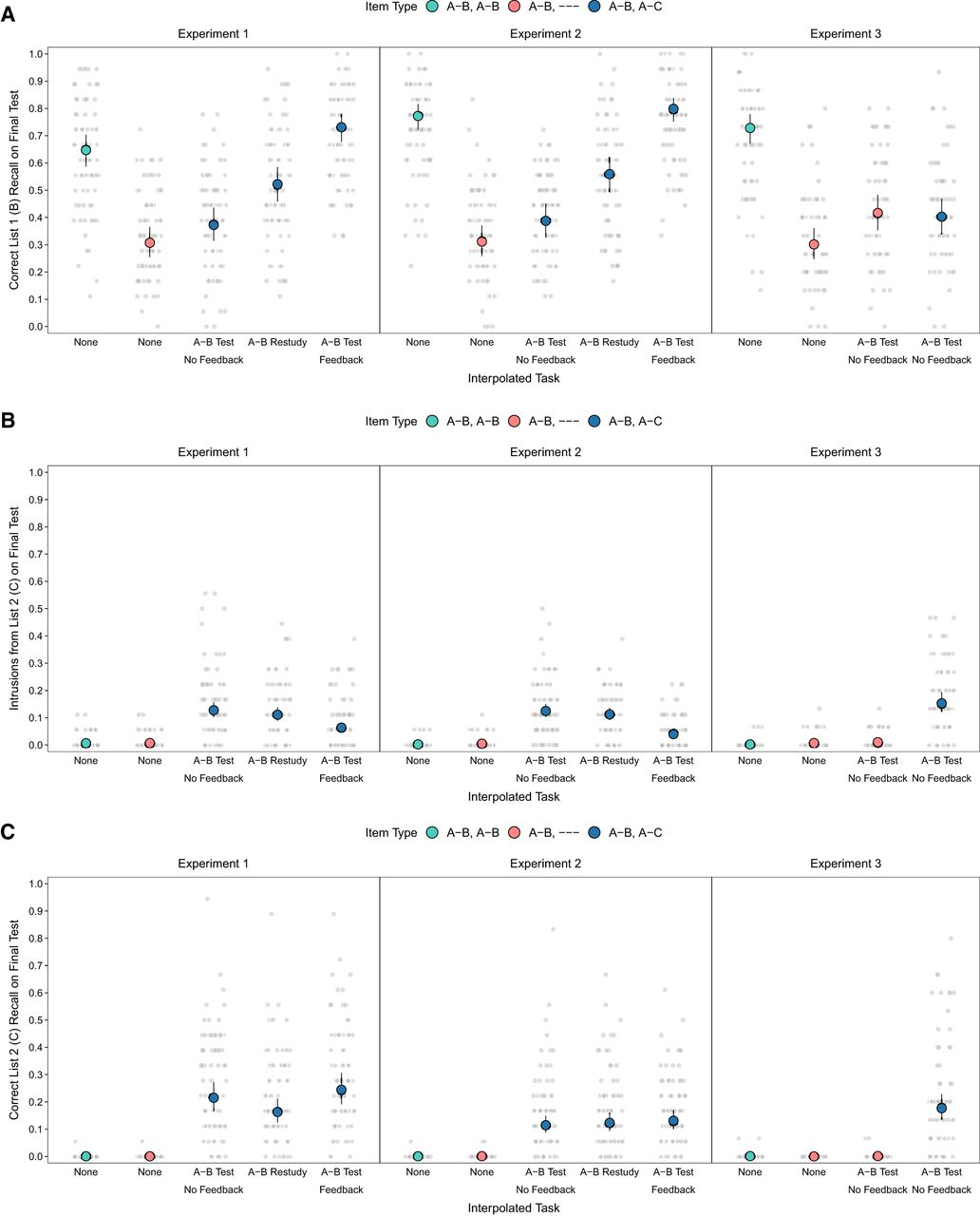
Correct list 1 recall (A), intrusions from list 2 (B), and correct list 2 recall (C) on the final test. The interpolated task labels on the X-axis of each panel indicate what happened with A–B pairs in the interpolated phase before participants learned A–C pairs in list 2. The interpolated tasks comprised cued recall tests of B responses without feedback (A–B test, no feedback), restudy of complete A–B pairs (A–B restudy), and cued recall tests of B responses with feedback (A–B test, feedback). The item type coloring indicates whether pairs appeared in an A–B, A–B condition that included the same cues (A) and responses (B) in lists 1 and 2; in an A–B, — condition that included list 1 A–B pairs that did not correspond to any list 2 pairs; or in an A–B, A–C condition that included the same cues (A) in each list and different responses in list 1 (B) and list 2 (C). Note that all C responses produced in the A–B, A–B and A–B, — conditions are extraexperimental intrusions. Those C response probabilities in B and C therefore show baseline estimates of participants guessing what would have been C responses for those items had they appeared in an A–B, A–C condition. The colored points are marginal means estimated from mixed-effect models, and error bars are the corresponding 95% confidence intervals. The gray points are individual participant probabilities.