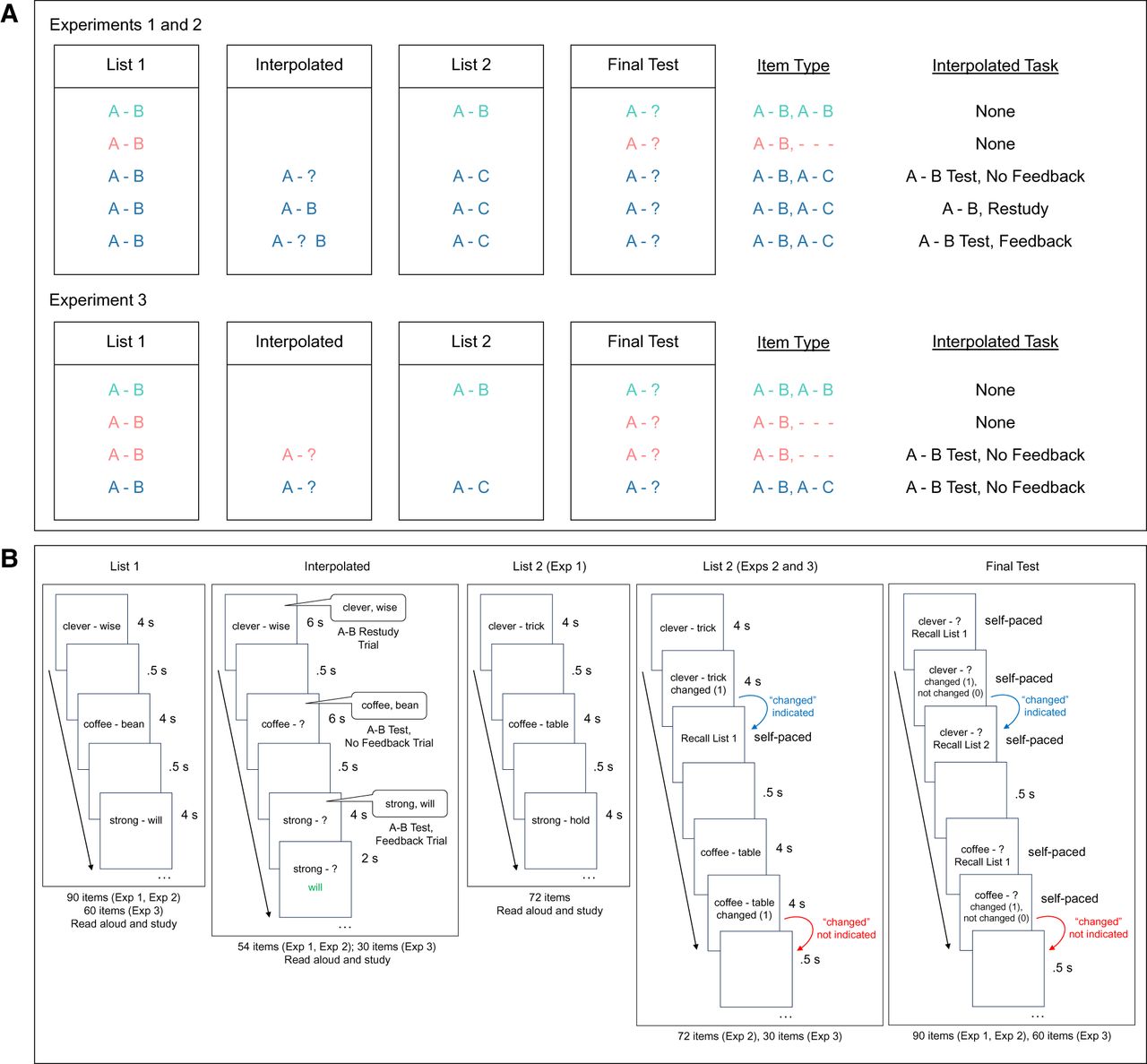
Schematics illustrating manipulations across conditions (A) and trial structures across all phases using examples of A–B, A–C item types (B). (A) Experiments 1 and 2 included five conditions, and experiment 3 included four conditions comprising combinations of varying relationships between cue–response word pairs in each list and tasks interpolated between lists. (B) During list 1, participants read aloud and studied word pairs. During the interpolated phase, participants restudied A–B pairs and attempted to retrieve B responses from other A–B pairs with or without feedback. During list 2, participants read aloud and studied word pairs (experiment 1) or studied word pairs, indicated whether responses changed from list 1, and if so, attempted to recall list 1 responses (experiments 2 and 3). On the final test, participants attempted to recall list 1 responses, indicated whether responses changed between lists, and if so, attempted to recall list 2 responses.