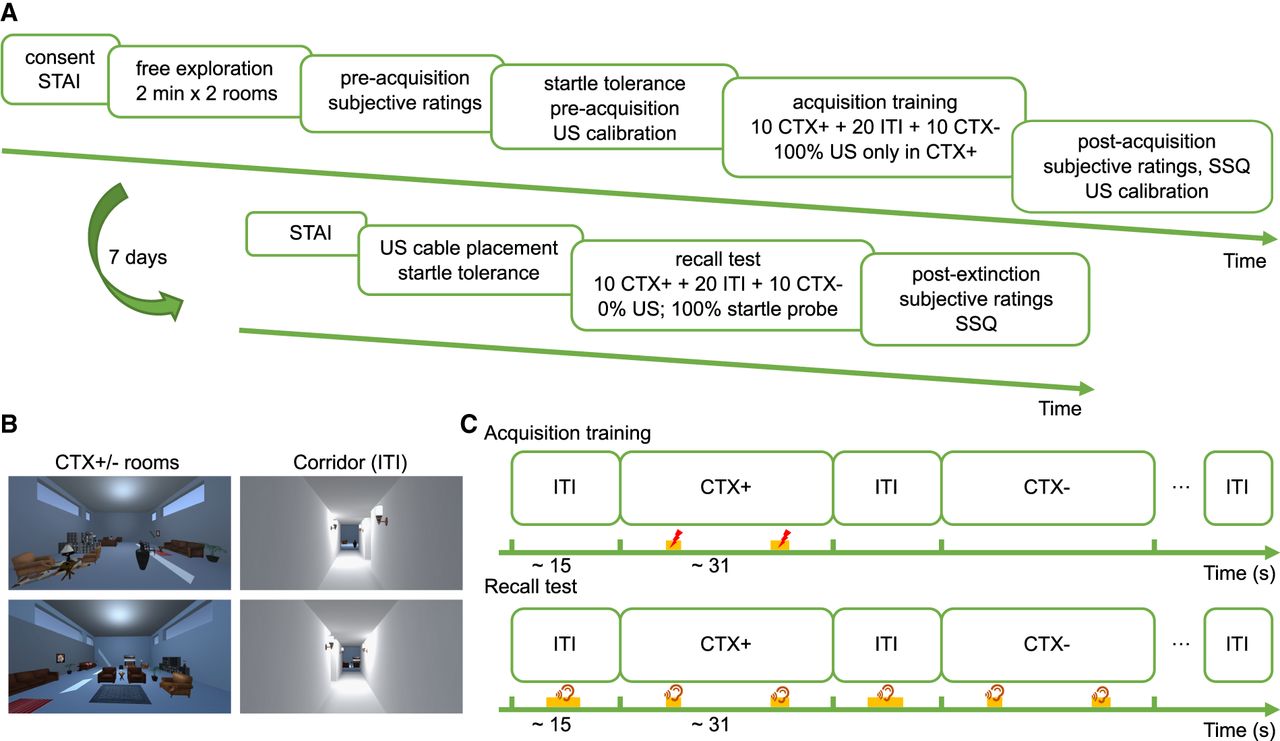
VR task used in experiments 1 and 2. (A) Study timeline. (B) 2D overview of the two experimental rooms and a white corridor. The two rooms were decorated as living rooms with the same furniture but in different arrangements with a blue background color. The white corridor linked the two rooms (CTX+/CTX−) and was visited during the intertrial interval (ITI). Assignment of CTX+/CTX− to rooms was counterbalanced between participants. Each room image depicted the participants’ view from the entrance. Participants moved passively through the rooms and the corridor in a predefined pseudorandom path. (C) Trial-by-trial design of the acquisition training and recall test. In the acquisition training, participants received overall 16 US: two in each of six CTX+ trials (one during 6–8 sec after entering the room and one during 21–24 sec) and one in each of the remaining four CTX+ trials (6–8 sec after entry). There were no USs in the recall test. To measure fear-potentiated startle eyeblink responses, one startle probe was delivered during each ITI, two were delivered during nine CTX+ and CTX− trials, and one was delivered for the remaining one CTX+ and CTX− trials. (SSQ) Simulator Sickness Questionnaire, (STAI) State-Trait Anxiety Inventory.