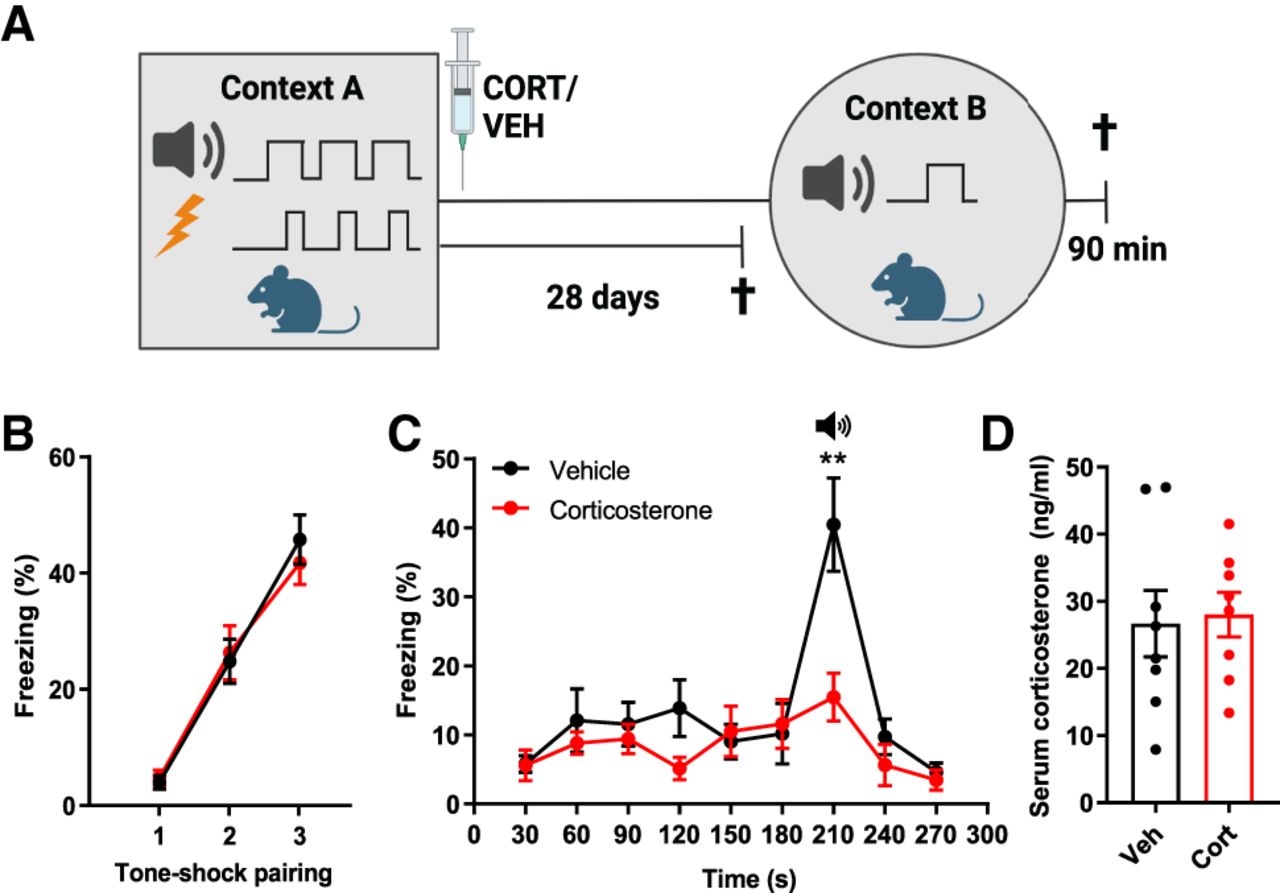
Corticosterone immediately after learning impaired remote auditory memory retrieval. (A) Schematic overview of the remote auditory fear conditioning paradigm. Mice received 2 mg/kg corticosterone (CORT) or vehicle (VEH) immediately after training in context A. After 28 d, remote auditory memory was tested in context B, and the mice were sacrificed 90 min after retrieval. The nonretrieval control group was sacrificed after 28 d to assess the baseline effects of the fear conditioning training paradigm with the CORT/VEH treatment on neuronal activity. Created with BioRender.com. (B) No difference in freezing levels was observed between the conditioning groups that were treated with vehicle and corticosterone, respectively, after training. (C) After 28 d, the mice were placed in a novel nonaversive context, and the previously conditioned auditory cue was presented again. A significant time × treatment interaction was present (F(3.29,46.12) = 5.19, P = 0.003). Post-hoc analysis revealed that this interaction is explained by a significantly higher level of freezing behavior in the VEH-treated mice compared with the CORT-treated mice upon presentation of the auditory cue (P < 0.01). (D) No differences were found in the serum corticosterone levels (in nanograms per milliliter). (**) Post-hoc Tukey effect P < 0.01. Data are presented as mean ± SEM. VEH n = 8, CORT n = 8.