Cover image
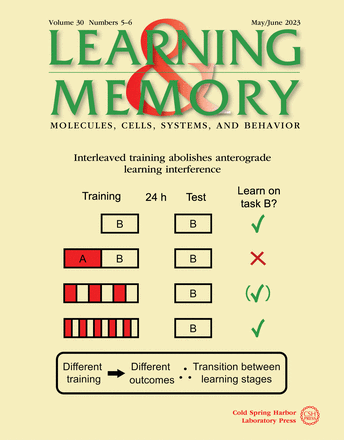
Training on one task can disrupt learning that would normally occur from subsequent training on another task, an outcome termed anterograde learning interference. Investigations into the nature of anterograde learning interference have focused primarily on the fate of the learning on the second, or target, task. Ning and Wright (LearnMem 101–109) instead focused on the first, or interfering, task. They report data from perceptual learning in humans suggesting that learning on the interfering task (task A) must be in a particular learning stage to induce anterograde learning interference on the target task (task B). Namely, for the same total number of training trials on task A and task B, anterograde learning interference only occurred when a sufficient number of consecutive training trials on task A had been reached. Thus, there appears to be a transition between two learning stages on task A, in only one of which task A is disruptive to learning on task B. That stage is presumably associated with consolidation. The cover art illustrates the learning outcomes on task B for four different training regimens: (top to bottom) baseline learning on task B, anterograde learning interference on task B from consecutive training on task A and then task B (blocked training), and the restoration of learning on task B from alternating training between task A and task B (interleaved training). (Cover illustration by Ruijing Ning and Beverly Wright.)