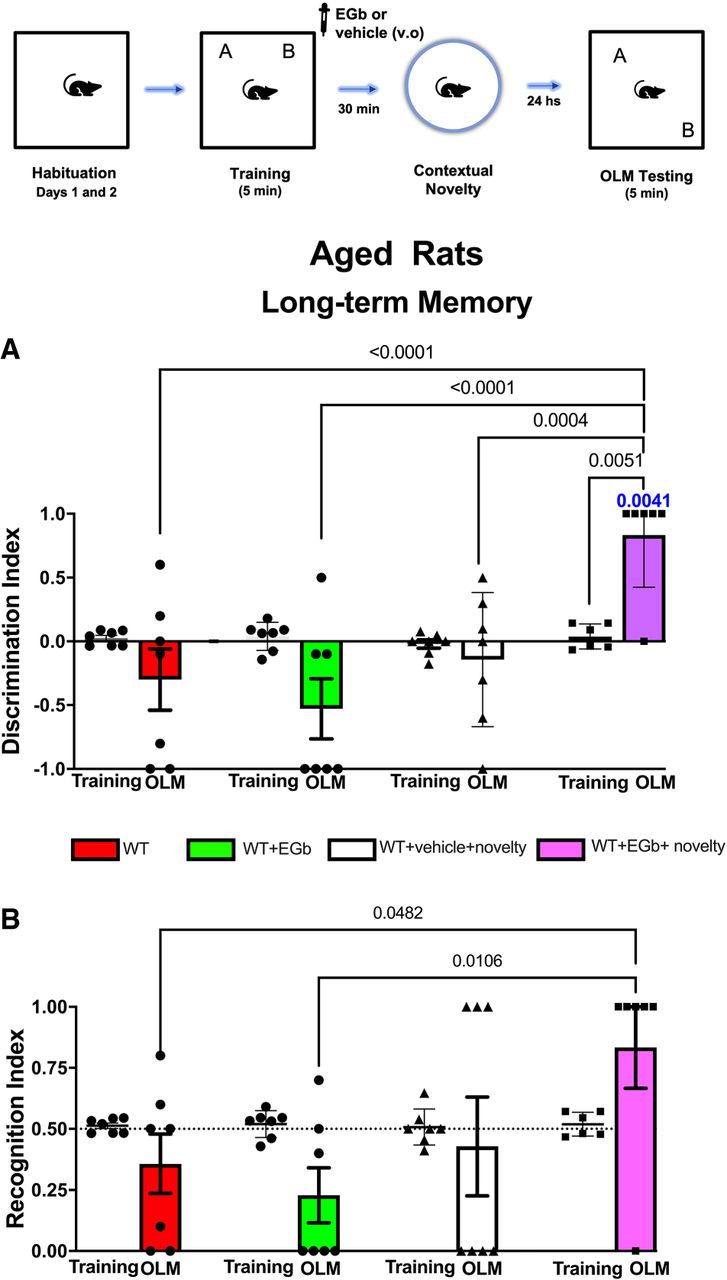
Schematic time line of the procedure for the acquisition and retrieval of object location memory (OLM). The data show the effect of treatment with standardized extract of Ginkgo biloba (EGb) immediately after a weak encoding session associated or not with contextual novelty (30 min after training) on long-term memory (LTM) sessions. In the training session, aged rats were allowed to freely explore the sample objects (A and B) for 5 min (weak training [WT]), and the mean discrimination index (DI) and recognition index (RI) of the sample objects were evaluated in an independent cohort of rats subjected to STM or LTM (n = 7–8 per group/time probe test). The DI (A) and RI (B) of the moved and sample objects were evaluated for 5 min in the object location memory testing (OLM) 24 h after training (LTM) for WT, WT + EGb, WT + vehicle + novelty, and WT + EGb + novelty (n = 7–8 per group/time probe test). All individual values are shown. The values are presented as the means (±SEMs). Lines represent the chance value for the DI (0.0) and RI (0.5). Comparisons between the ratio discriminations from the group above chance level used one-sample t-tests (blue value). Intragroup comparisons (testing vs. training sessions) used a paired t-test and revealed the effects of EGb associated with novelty in LTM.