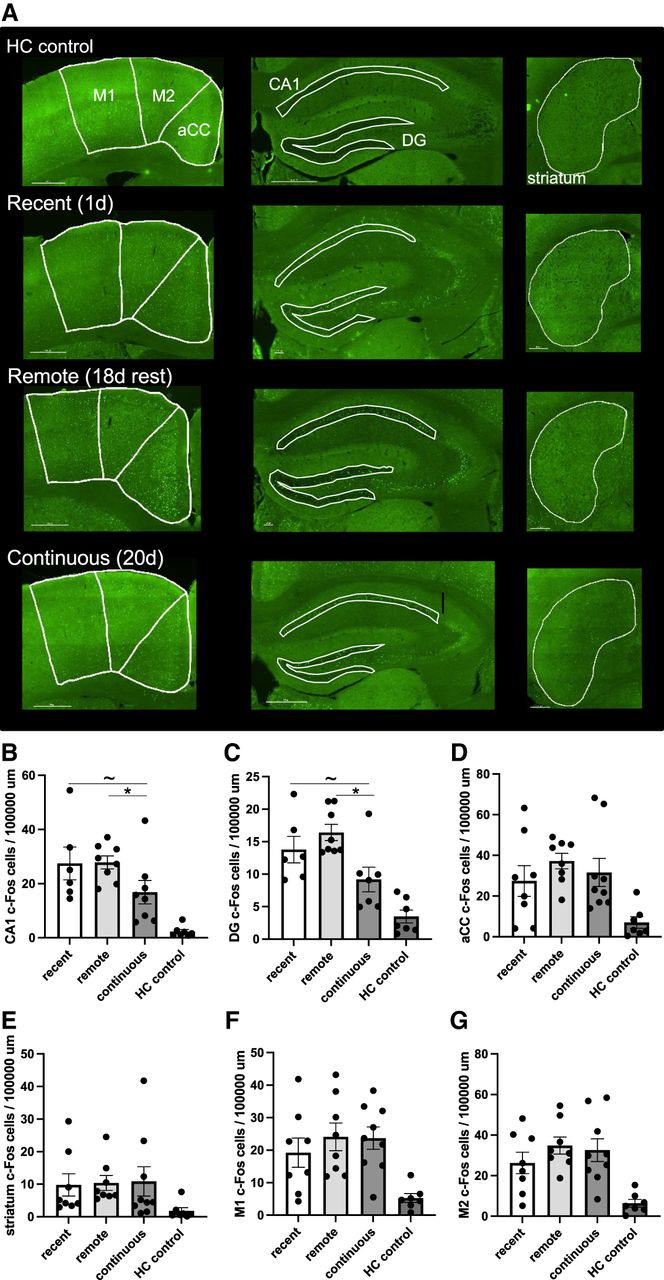
Continued hippocampal engagement over time is sensitive to the relative novelty of the motor task. (A, left) Representative c-Fos expression in the aCC and motor cortices (M1 and M2) for each training condition (recent, remote, and continuous training and home cage [HC] control groups). (Middle) Representative c-Fos expression in the hippocampus (CA1 and DG) for each experimental condition and HC control group. (Right) Representative c-Fos expression in the striatum for each experimental condition and HC control group. Scale bar, 500 µm. (B,C) Mean c-Fos expression levels in the CA1 (B) and DG (C) were significantly higher following remote motor testing relative to the continuous training levels on day 20, suggesting that continued hippocampal engagement over time depends on the relative familiarity of the motor task. (D) Mean c-Fos expression in the aCC was insensitive to age or familiarity of the motor memory. All groups show an activity-induced increase in c-Fos expression relative to HC control levels in the hippocampus and aCC. (E–G) No significant differences in c-Fos expression levels in the striatum (E), M1 (F), or M2 (G) were observed between training conditions. Error bars represent the SEM. (aCC) Anterior cingulate cortex, (DG) dentate gyrus, (d1) training day 1, (d20) training day 20, (HC) home cage control, (M1) motor cortex 1, (M2) motor cortex 2, (SEM) standard error of the mean. (*) P < 0.05, (∼) P < 0.06.