Cover image
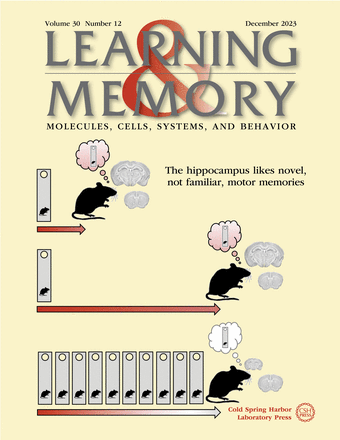
Nondeclarative memories, including memories for motor tasks, are not thought to require the engagement of the hippocampus for successful retrieval. However, so long as it exists, the hippocampus may continue to be engaged during motor task acquisition and retrieval, especially for recently acquired motor memories that remain tied to the episode during which the task was first learned. There is debate as to whether a time-dependent transformation of the episodic-like memory network is observed for nonepisodic tasks, including motor memory. To determine how motor memory networks reorganize with time and practice, Sullens et al. (LearnMem 320–324) had mice perform a motor task in a straight alley maze for 1 d (recent), 20 d of continuous training (continuous), or testing 20 d after the original training (remote). Elevated hippocampal c-Fos accompanied remote, but not continuous, motor task retrieval, indicating that the hippocampus remains engaged during retrieval of relatively novel, but not familiar, remote motor memories. c-Fos levels in the aCC did not differ during remote motor testing, regardless of the level of familiarity. Their findings support the idea that a similar pattern of systems consolidation and memory network reorganizational processes in the hippocampus is observed across declarative (episodic) and nondeclarative (motor) memory, with familiarity, not time, mediating the continued engagement of the hippocampus during task retrieval. (Cover illustration by Melanie Sekeres.)