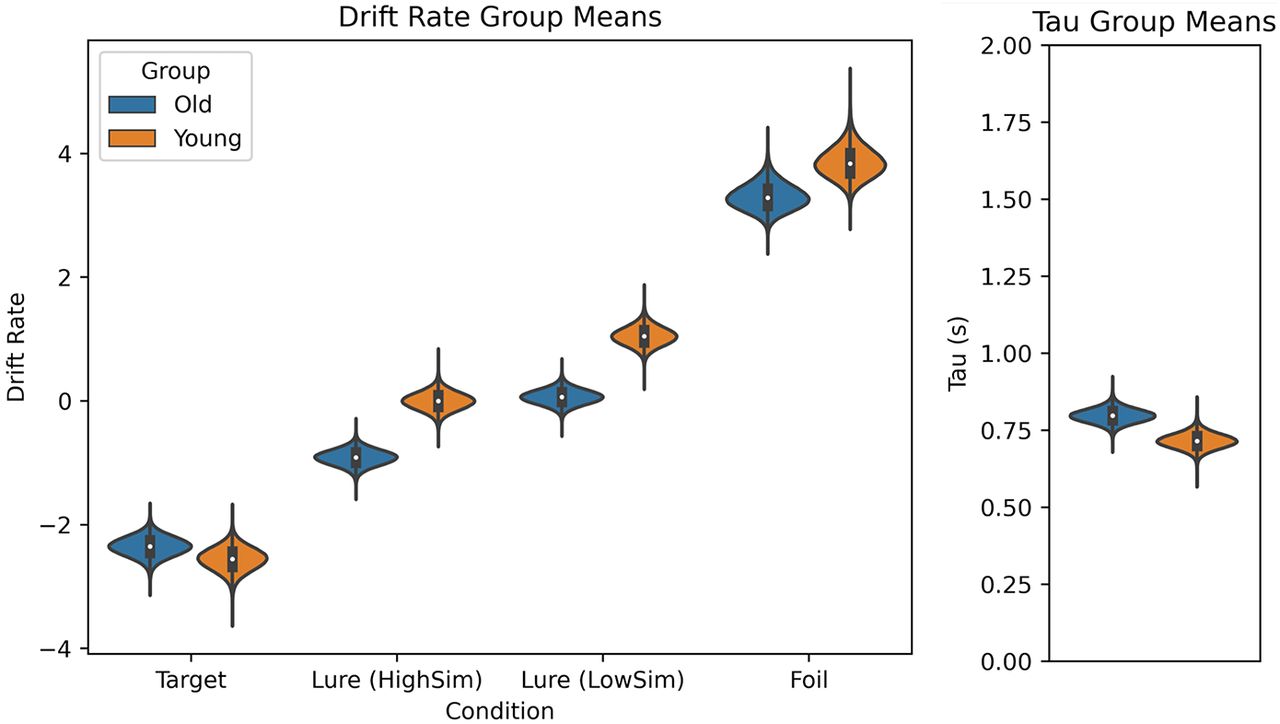
(Left) Estimated drift rate (δ) group means (means of the posterior distributions at the group level) for older and younger adults for all four conditions. A negative drift rate represents, on average, “old” responses. A positive drift rate represents, on average, “new” responses. Older adults show a drift rate of ∼0 for the lure (LowSim) condition, indicating, on average, that they were not able to accumulate evidence toward either of the response boundaries (similar to younger adults in the lure [HighSim] condition). A negative drift rate in the lure (HighSim) condition indicates, on average, that older adults accumulate evidence toward the incorrect “old” response for highly similar lures. (Right) Estimated nondecision time (τ) group means for older and younger adults. Older adults have a 90-msec longer nondecision time.