Cover image

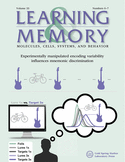
When exposed to a range of environmental stimuli, our brains can involuntarily extract probabilistic associations among different elements through statistical learning, a process assumed to be underpinned by implicit and explicit memory systems. Previous research has shown that different levels of predictability can engage exploitation and exploration mechanisms during associative learning. Nevertheless, how input uncertainty influences these mechanisms during implicit statistical learning remains unknown. Using a novel cueing validation paradigm, Zhang et al. (LearnMem 282–295) examined how cues with different predictability levels are represented in response to preceding targets with varying transitional probabilities. Their results show that lower-uncertainty cues trigger exploration-like mechanisms regardless of whether learners are aware of the regularities, while higher-uncertainty cues engage exploitation-like mechanisms in learners who are aware of the regularities, thus regulating the involvement of implicit and explicit systems of statistical learning. The cover image exemplifies how preceding event uncertainty can influence the representation of associated information. For instance, humans tend to associate boats more strongly with beaches than with city streets. As a result, when a boat is sighted on a beach (lower uncertainty), people's perception of the beach is diminished. Conversely, when a boat is seen on a city street (higher uncertainty), individuals may retrieve the information associated with the boat, leading to an enhanced representation of the beach. (Cover illustration created by Mei Zhou, Arpitha Vasudevamurthy, and Stephen Man Kit Lee.)