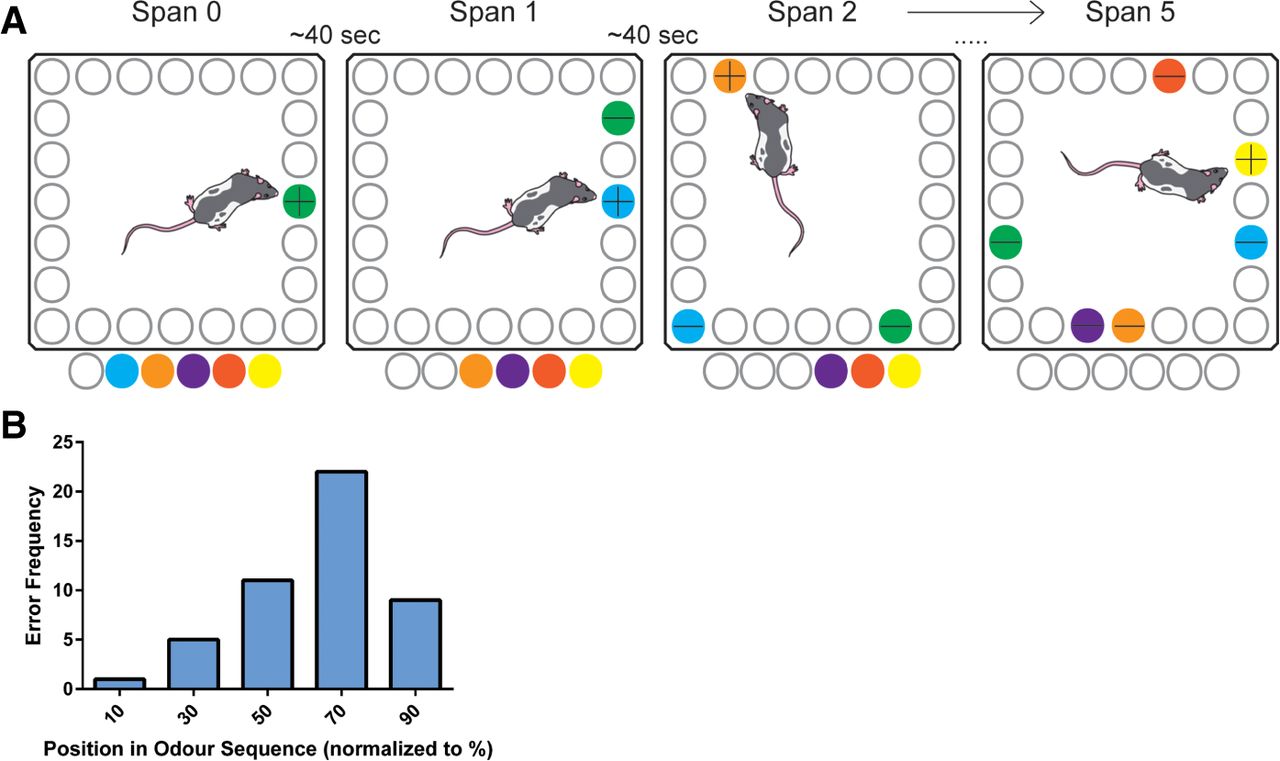
(A) Illustration showing the basic procedure used in the OST. The OST is an incrementing DNMTS task using olfactory stimuli that is used as a measure of olfactory WM capacity in rodents (Dudchenko et al. 2013). (B) Frequency histogram of errors in the OST as a function of percentage of progress through the sequence of presented odors compiled from pooled data from Saline-infused rats. The OST exhibits a striking pattern of error frequency as a function of the sequential position of the incorrectly chosen odor in odor presentations. Incorrectly chosen odors are typically those located ∼70% of the way through the odor sequence, while odors occurring nearer the beginning or end of the sequence are less likely to be incorrectly chosen.