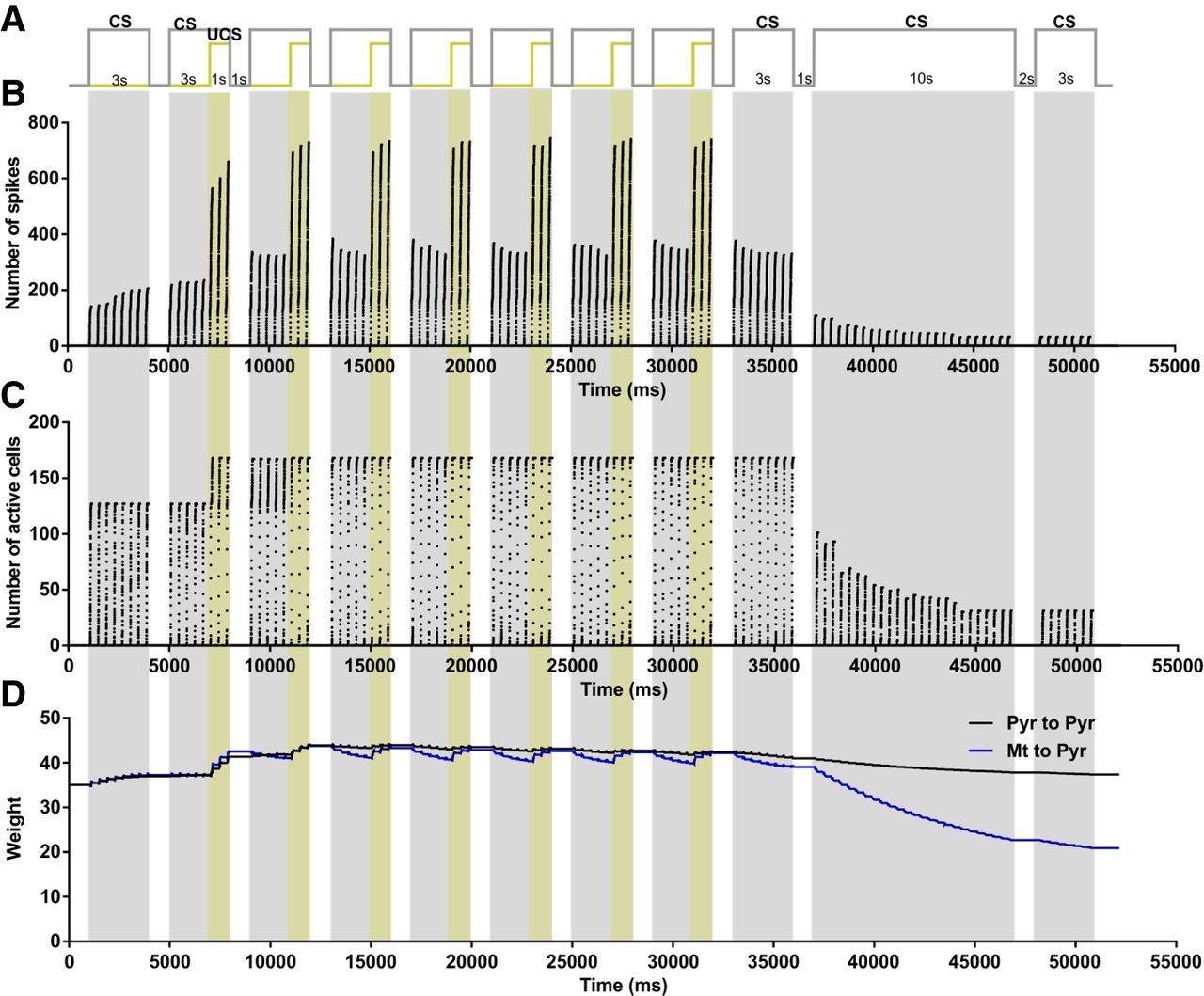
Simulation of maternal odor preference learning in P5–P8 aPC pyramidal cells and exposure to the conditioned maternal odor in P14–P17 aPC pyramidal cells. (A) Protocol for classical conditioning of maternal odor preference in the nest. A delayed pairing procedure was used in which the CS (maternal odor) onset preceded the UCS (maternal care, NE action) onset by 2 sec. CS and UCS overlapped for 1 sec, after which the CS was terminated. The CS–UCS pairing was presented seven times with 1s intervals for the network with aPC having parameters compatible with the P5–P8 age. Learning was tested by the presentation of CS during 3 sec. After the test, the network had its parameters shifted to the P14–P17 age and the CS alone was presented again during 10 sec. After 2-sec of interval, learning was tested again by the presentation of CS during 3 sec. (B) Number of cumulative aPC pyramidal cell spikes during the CS–UCS pairing and CS presentation, collected at every 100 msec of simulation. (C) Number of active aPC pyramidal cells during the CS–UCS pairing and CS presentation, collected at every 100 msec of simulation. (D) Synaptic weight gain of Pyr–Pyr (black curve) and Mt–Pyr (blue curve) synapses during CS–UCS pairing and CS presentation. Excitatory mitral inputs fire at the respiratory rhythm (2 Hz). Bin 0.5 msec.