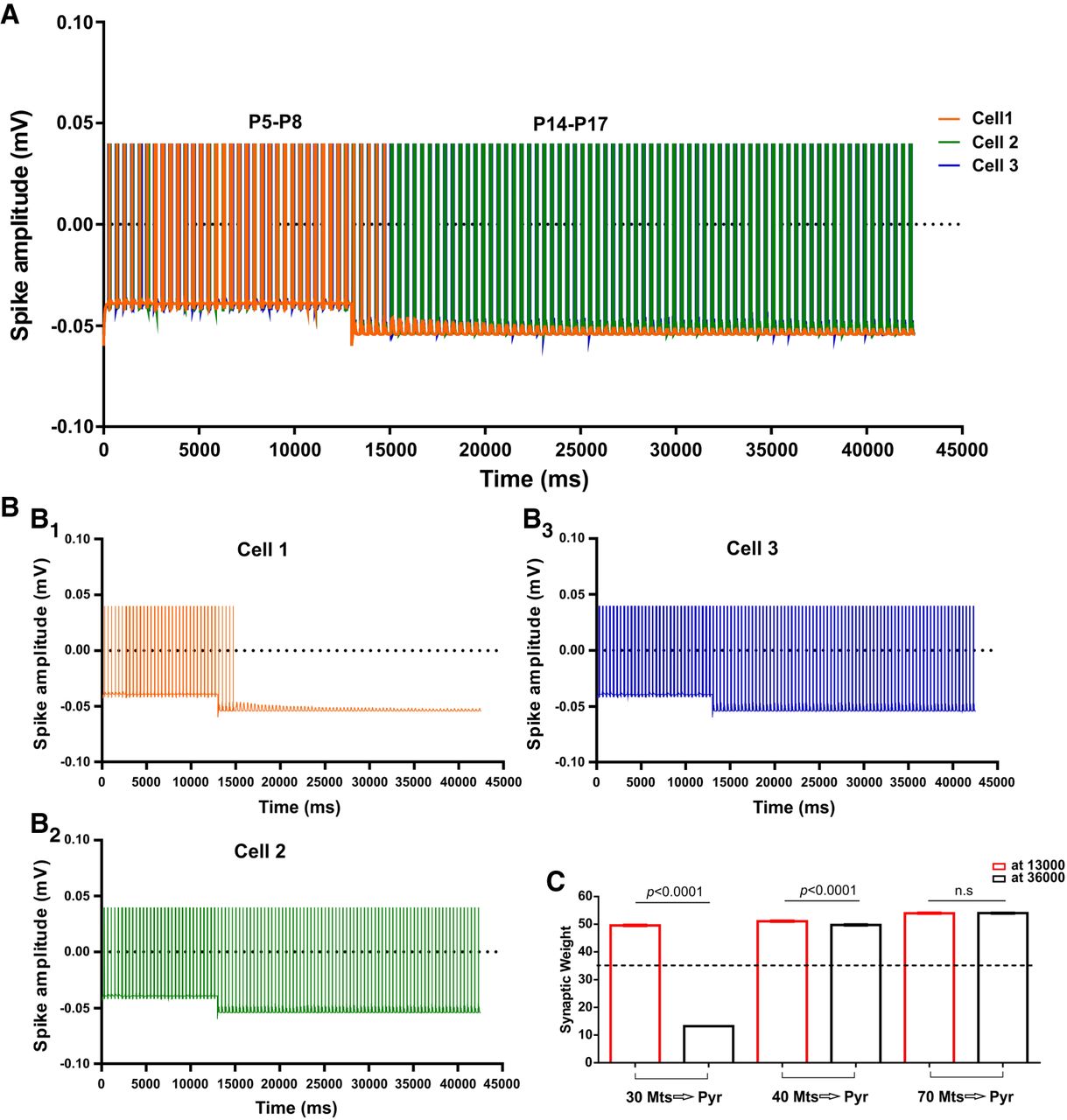
Simulation of the evoked activity in aPC pyramidal cells during the switch in intrinsic properties from P5–P8 to P14–P17. We simulate the Mitral-Pyramidal circuit and the evoked spikes of three random choices of pyramidal cells (color traces) recorded when receiving input from 50 random mitral cells firing at respiratory rhythm of 2 Hz (A). Initially, the passive and active membrane properties of these pyramidal cells were set up to represent the profile of the P5–P8 age period and after approximately 10,000 msec of simulation, the passive and active properties membrane properties of pyramidal cells were switched to represent the profile of P14–P17 age period. Note the large hyperpolarization in the resting membrane potential of the three neurons during the change of their membrane potential values, which continues steadily until the end of the simulation. Interestingly, the Cell 1 (orange traces) stops its firing after the switch of membrane properties values, but the Cell 2 (green trace), and Cell 3 (blue trace) continue to firing steadily until the end of the simulation. In the same simulation, we recorded the synaptic changes of those pyramidal cells receiving inputs from 30, 40, and 70 random mitral cells (C) and recorded the average of synaptic weight at the end of 13,000 msec (red bar) and 36,000 msec (black bar) of simulation. Pyramidal cells receiving inputs from 30 mitral cells show a synaptic weight gain after 13,000 msec but not after 36,000 msec. On the other hand, the pyramidal cell receiving inputs from 40 and 70 mitral cells show a steady synaptic gain during all simulation periods. Δt: 0.5 msec; Bin: 0.5 msec.