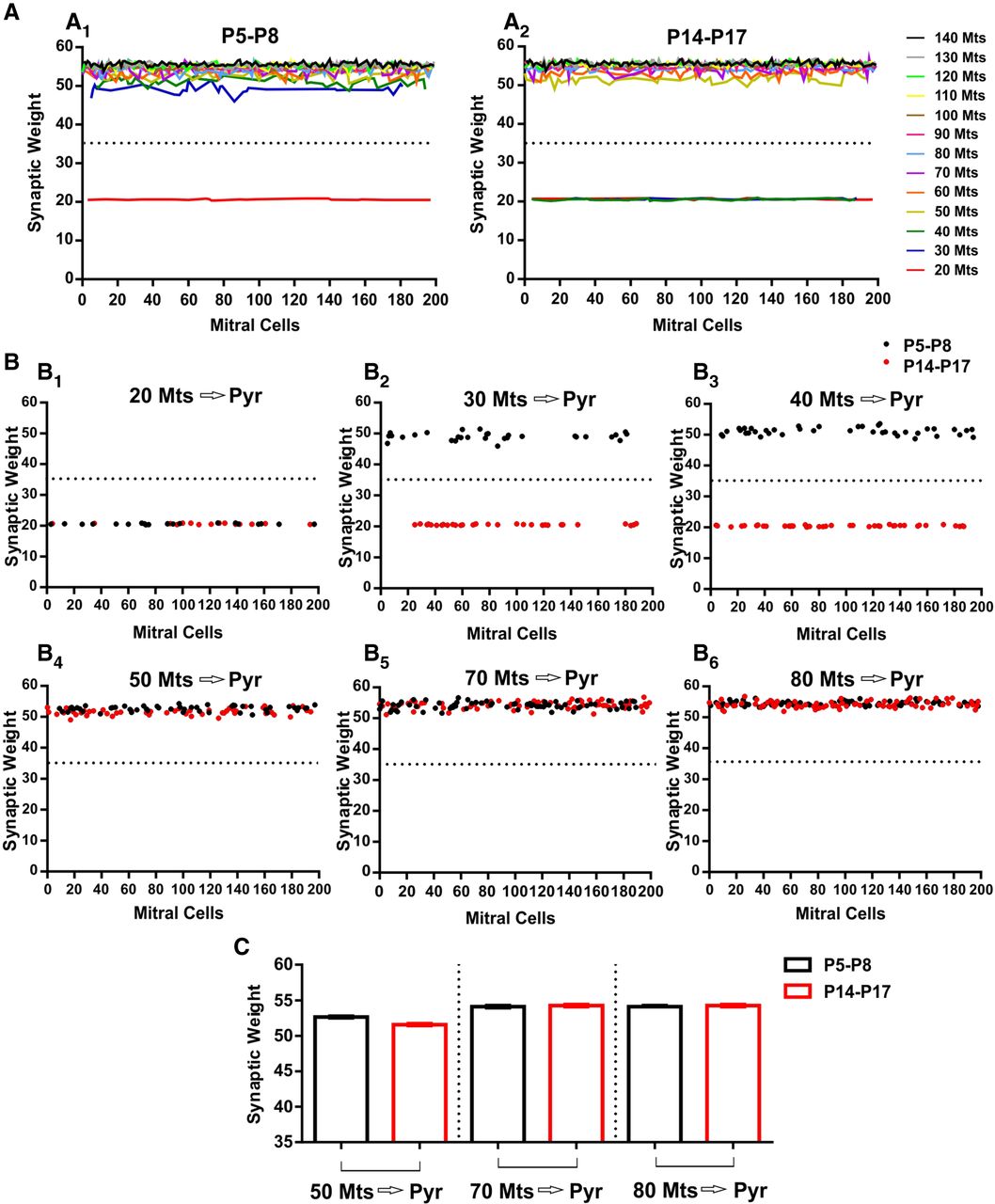
Simulation of plasticity weight change at mitral-pyramidal cells synapses across 6000 msec simulation period for P5–P8 and P14–P17 age group. The circuit formed by 200 mitral cells and 13 pyramidal cells was simulated during 15 respiratory cycles. Each pyramidal cell receives random inputs from 20 to 80 mitral cells firing at respiratory rhythm of 2 Hz (color curves), and their activities induce changes in the synaptic weights of the OB-aPC circuit (A). Inputs from 30 to 140 mitral cells (A1) or from 50 to 140 mitral cells (A2) induce gain in synaptic weight (plotted from synaptic weight before simulation, 35) at P5–P8 and P14–P17, respectively. Note that only inputs from 20 mitral cells induce loss of synaptic weight in pyramidal cells from the P5–P8 group, but inputs from 30 or more induce a great gain of synaptic weight (B1), which occurs with 50 or more mitral cells inputs for the P14–P17 age group (B1–B6). When we look closer at the circuit when the two-age groups gain synaptic weight (C), we can note that 50 Mt–Pyr circuits gain more weight in the P5–P8 group than in the P14–P17 group and as the number of mitral cells inputs increase (70 and 80 Mt–Pyr circuits), the gain of synaptic weight become similar for the two ages.