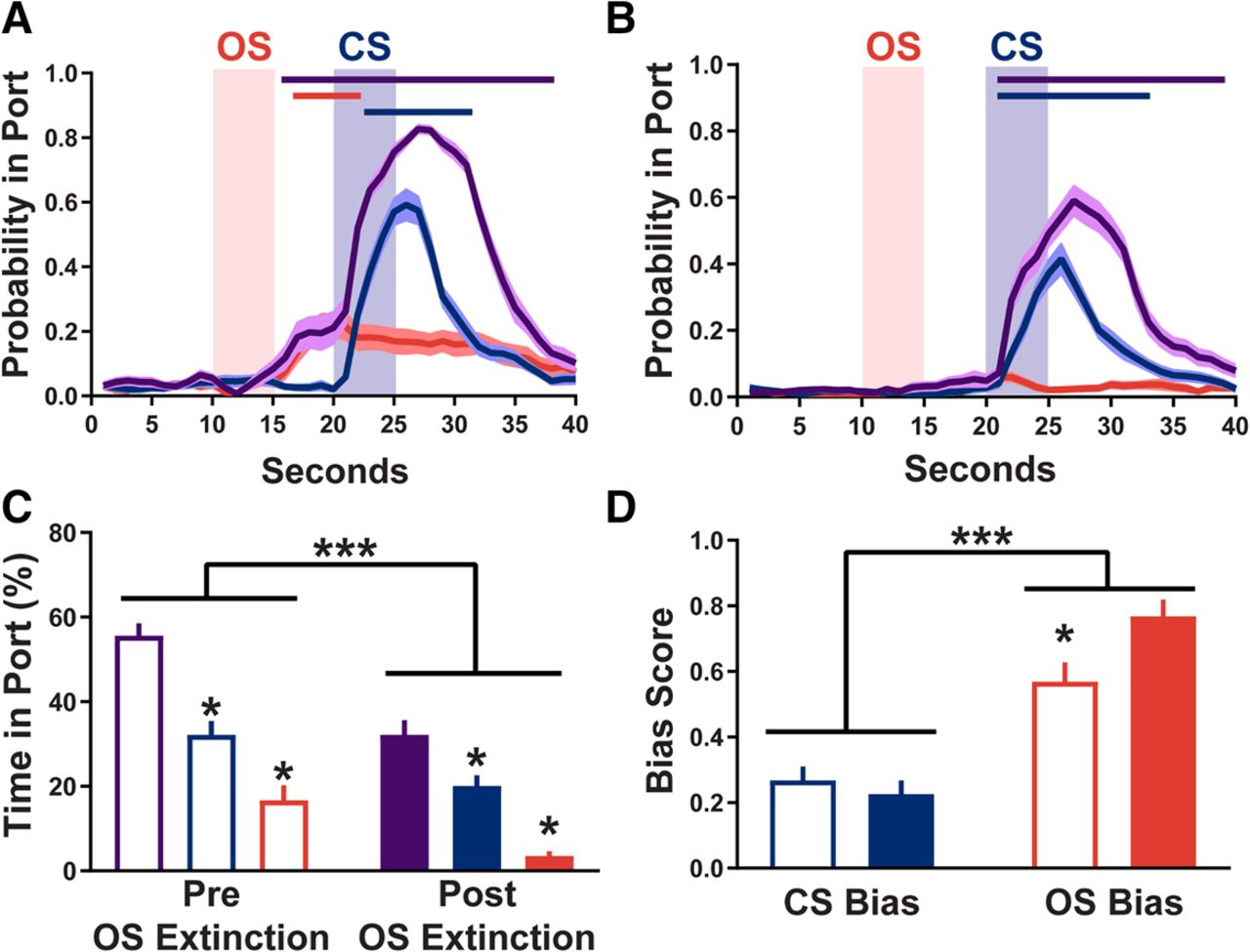
Extinction of an OS does not impair its ability to enhance the predictive value of its CS. (A) Probability of observing a rat in the reward port across each trial type during the initial extinction test (Interaction between seconds and trial type F(78,1482) = 42.69, P < 0.0001). Lines indicate periods when OS + CS trials are significantly greater (Bonferroni post hoc P < 0.05) than CS alone (purple) and CS alone is significantly greater than OS alone (blue), and OS alone is significantly greater than CS alone (red). (B) Probability of observing a rat in the reward port across each trial type in the second extinction test following OS extinction (Interaction between seconds and trial type F(78,1482) = 40.52, P < 0.0001). Lines indicate periods when OS + CS trials are significantly greater (Bonferroni post hoc P < 0.05) than CS alone (purple) and CS alone is significantly greater than OS alone (blue). (C) Normalized percent time in port during the CS period for each extinction test. Purple represents reinforced trials, blue represents CS alone trials, and red represents OS alone trials. (D) Discrimination scores for each extinction test. Empty bars represent data from the session prior to OS extinction and filled bars data from the session following OS extinction. For all figures symbols indicate mean ± SEM. (OS) occasion setter, (CS) conditioned stimulus. (***) P < 0.05 for main effects; (*) P < 0.05 for post-hoc comparisons.