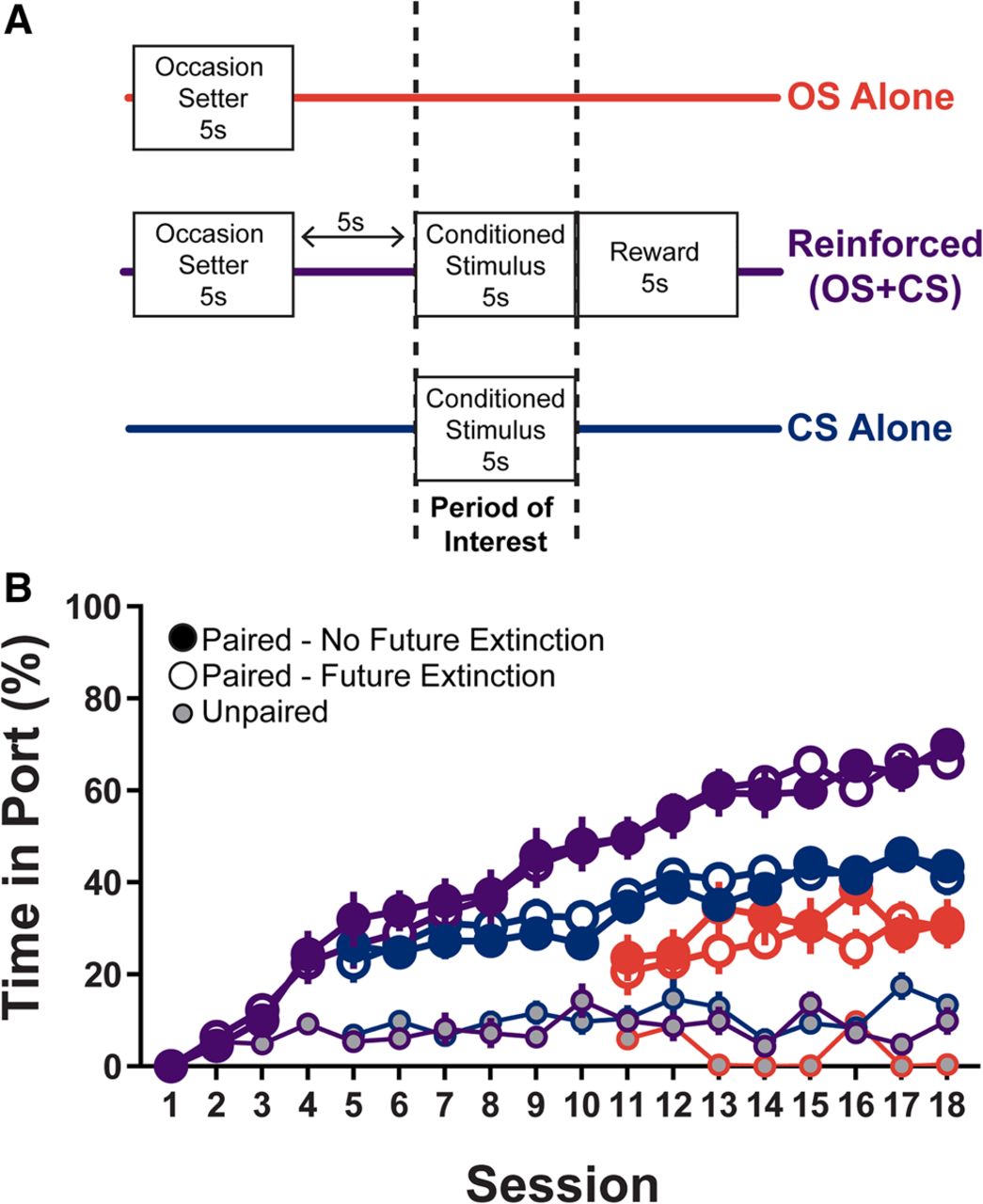
A novel model for occasion setting. (A) Schematic of the final stage of the occasion setting task. In each session rats randomly receive one of three trials types, 10 of each per session. Only when the OS and CS are paired (with a 5 sec gap between) is the termination of the CS followed by reward delivery. (B) Normalized percent time in port during the CS period across training. Paired rats reinforced as in A acquire discriminatory responding in the task, and this is not true for Unpaired rats receiving truly random delivery of reward (n = 10; small gray circles). Paired rats who would (n = 20; open symbols) or would not (n = 20; solid symbols) undergo OS extinction following training did not differ from each other at any point during training. Data are presented as mean ± SEM. (OS) occasion setter, (CS) conditioned stimulus. Purple represents reinforced trials, blue represents CS alone trials, and red represents OS alone trials.