Cover image
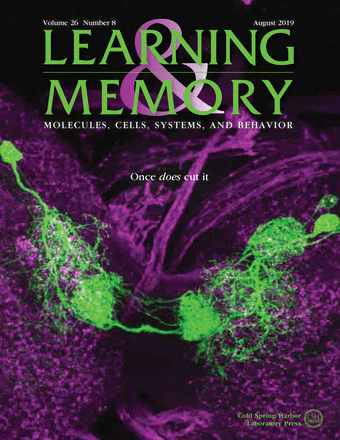
You would think once doesn't cut it—but Weiglein et al. (LearnMem 26: 109–120) show that animals as simple as larval Drosophila are capable of “small data,” one-trial associative learning. One odor-food conditioning trial suffices toward that effect when using high-concentration salt as punishment, or sugars as a reward. Likewise, a single odor presentation together with optogenetic activation of a small set of rewarding dopaminergic mushroom body input neurons establishes appetitive memory for the odor. The image shows the mushroom body region of a larval brain expressing the optogenetic effector ChR2-XXL in these dopaminergic neurons (green, labeled with an anti-ChR2-XXL mouse antibody); neuronal membranes are labeled for better orientation in the preparation (magenta). Scale bar is 25 µm.