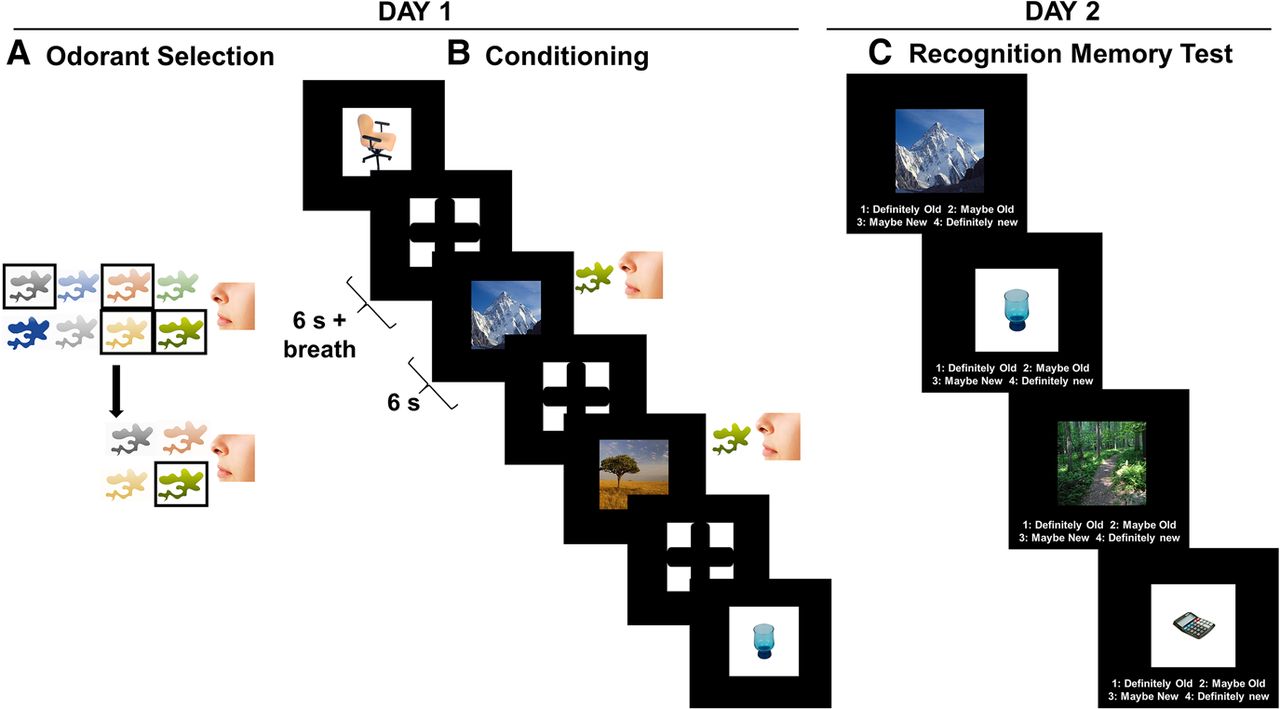
Experimental design. Participants first completed an odor selection procedure which involved a two-part rating procedure (A) to determine which odorant would be used as the US. Participants first rated eight odorants experienced via air puffs on valence and arousal measures in order to narrow this down to four odorants that were experienced via the olfactometer and rated to identify the US (for more details, see Materials and Methods). Immediately afterwards, participants underwent aversive olfactory Pavlovian category conditioning, using a breath-triggered paradigm, in which one category of images (CS+) was reinforced 50% of the time and the other category (CS−) were never reinforced (B). Participants returned 24 h later and completed a self-paced recognition memory test that included all the images observed on day 1, plus an equal number of new images from each category (C).