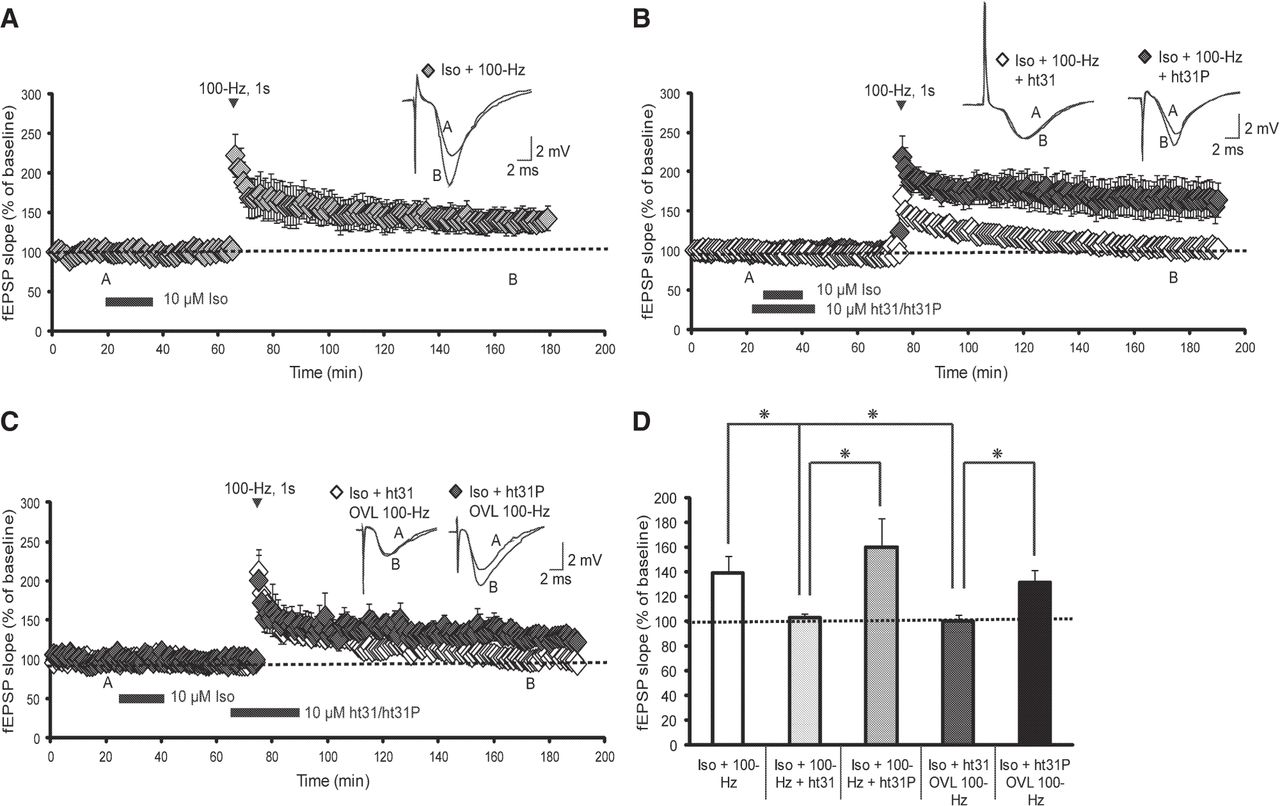
Intact PKA anchoring is required for stable, metaplastic induction of LTP. (A) Iso-primed synapses for subsequent long-lasting potentiation induced by 100-Hz given 30 min after washout of Iso (n = 6). (B) Application of stearated ht31 (white symbols, n = 7), a peptide inhibitor of AKAPs, during the priming Iso stimulus, blocked LTP maintenance. fEPSPs decayed to pre-100-Hz baseline within 90 min after LTP induction by 100-Hz. In contrast, an inactive, stearated ht31 peptide (“ht31P,” n = 8, dark gray symbols) did not affect the stabilization of LTP over the time course of these experiments. (C) Shifting application of the active ht31 peptide (white symbols, n = 7) to overlap (“OVL”) with 100-Hz stimulation significantly reduced the longevity of Iso-primed LTP, whereas applying 100-Hz in the presence of ht31P (dark gray symbols, n = 5) had no significant effect. (D) Histogram showing mean fEPSP slopes measured at 100-min post-100-Hz. * represents different P values: P < 0.01 for Iso + 100-Hz versus Iso + 100-Hz + ht31 group; P < 0.00001 for Iso + 100-Hz + ht31 group versus Iso + 100-Hz + ht31P inactive peptide group; P < 0.001 for Iso + 100-Hz versus Iso + ht31 OVL 100-Hz; P < 0.00001 for Iso + ht31 OVL 100-Hz versus Iso + ht31P OVL 100-Hz. Sample fEPSP traces were obtained at time points marked “A” and “B” on x-axes of graphs.