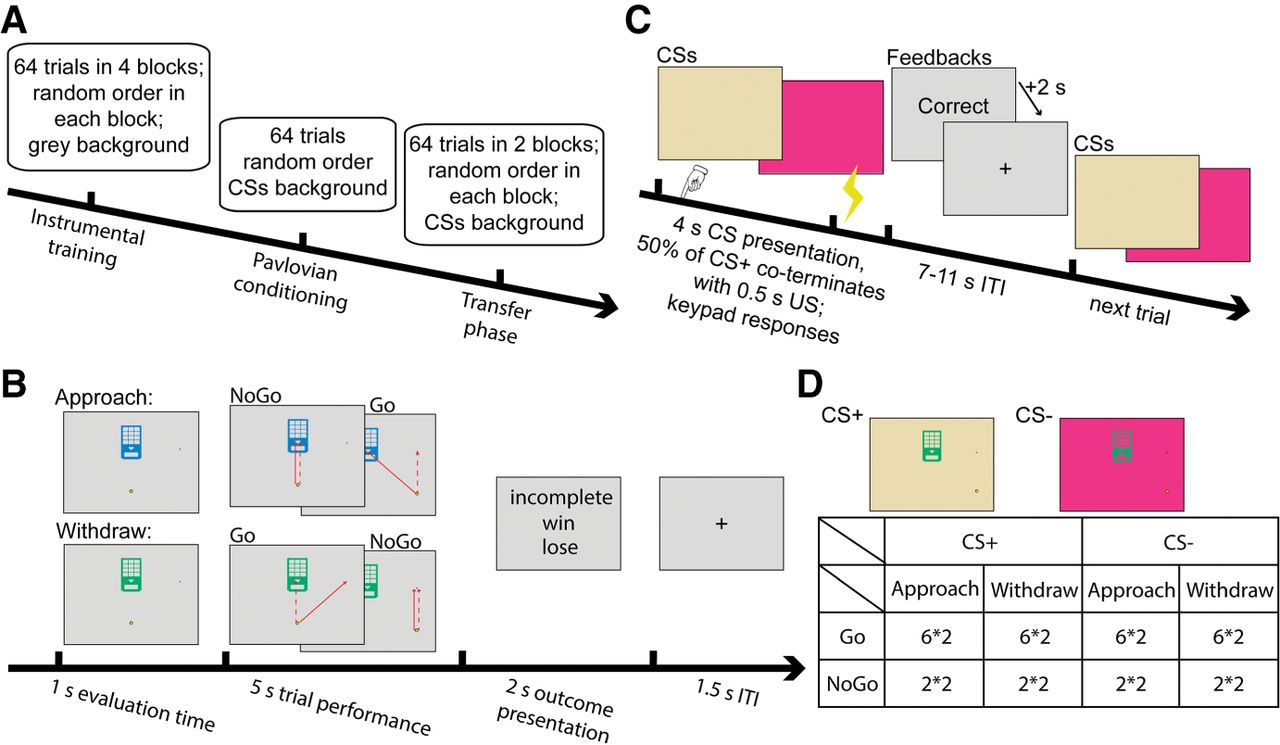
PIT task. (A) Task phases in Experiment 2. Experiment 1 had a similar structure, but instrumental training phase and transfer phase were not split into balanced blocks of trials. (B) Instrumental phase. A vending machine, a target dot, and a coin were placed on the gray screen. Participants had 1 sec time to evaluate the trial specification, and 5 sec to perform the task. Solid red lines show the correct route of coin to win a chocolate. Dashed lines show the default route. These lines were not presented to the participants. Outcome feedback (incomplete, win, and lose) was presented for 2 sec after the trial ended. In Experiment 1, ITI lasted 2.5 sec and in Experiment 2 it was reduced to be 1.5 sec. (C) Pavlovian phase. A CS background (yellow or pink) was presented for 3.5 sec in Experiment 1 and for 4 sec in Experiment 2. In both Experiments, 50% of CS+ coterminated with 0.5-sec electric shocks. Participants were asked to respond the background color by pressing a corresponding key. Response feedback (“correct,” “incorrect,” “no response,” “only press RIGHT or LEFT”) was shown for 2 sec after the trial. During ITI, a fixation cross was presented on screen center. In Experiment 1, ITI was 2.5 sec. In Experiment 2, ITI was randomly drawn from a uniform distribution between 7 and 11 sec. (D) Pavlovian-to-instrumental transfer phase. Instead of gray background, the instrumental task was presented with CS-colored background. There was no Pavlovian reinforcement, and the instrumental outcome feedback on each trial was replaced by “balance updated,” leaving all other settings same as in instrumental phase. Participants performed eight trials for each type in Experiment 1. For Experiment 2, number of trials per condition is shown in the table. CS, conditioned stimulus; ITI, intertrial interval; US, unconditioned stimulus.