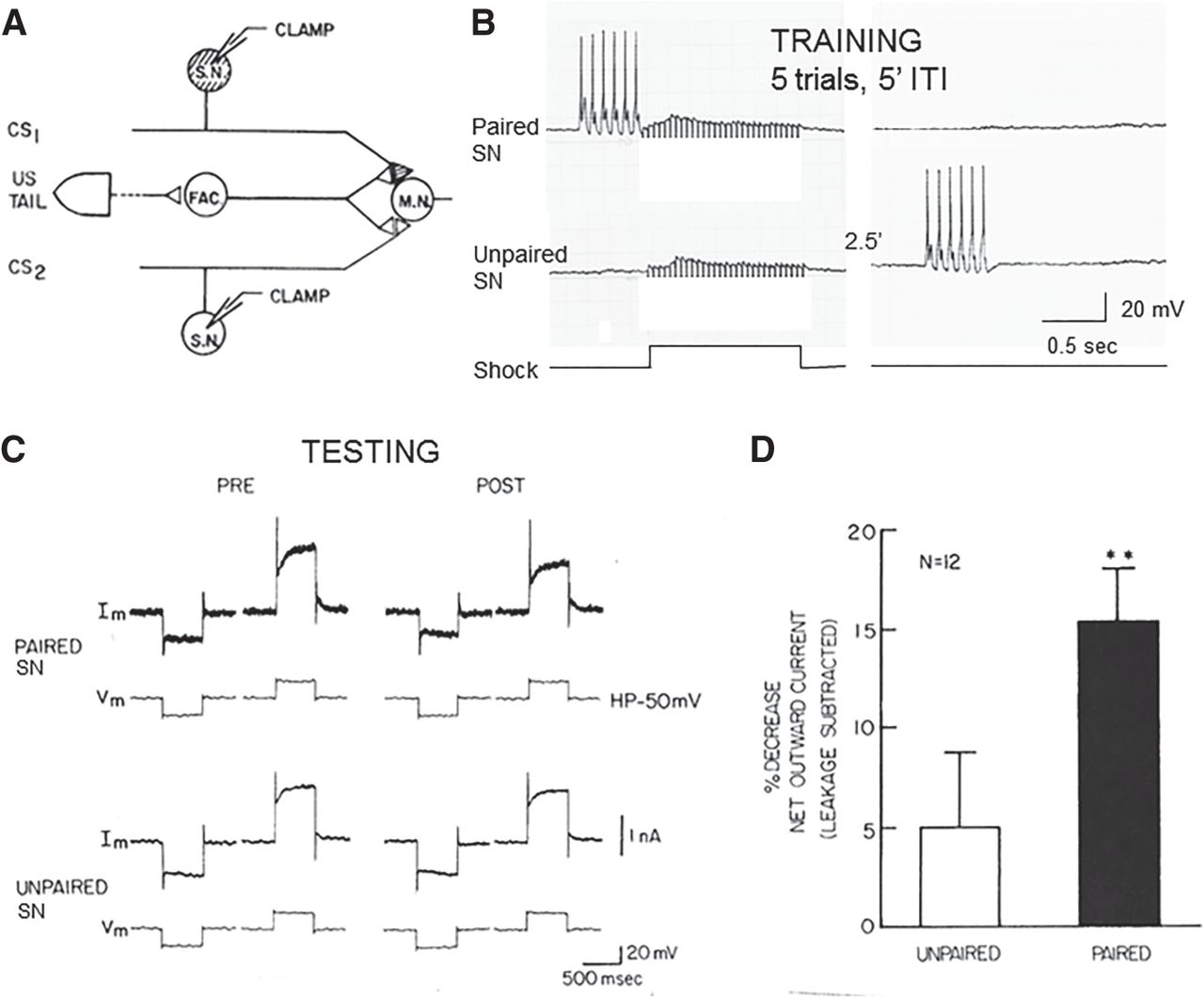
A training procedure for differential facilitation in Aplysia produces a differential decrease in an outward current in the SNs. (A) The experimental preparation. (B) An example of one training trial in which a brief train of action potentials in the paired SN started 0.5 sec before shock to the posterior pedal nerves (indicated by the shock artifacts) and a train of action potentials in the unpaired SN started 2.5 min later. There were five training trials with a 5 min ITI. (C) An example of testing 5 min before (Pre) and after (Post) training. We measured the outward current in each SN during a 500 msec, 20 mV depolarizing voltage clamp pulse from a holding potential of −50 mV. We also measured the inward current during a 20 mV hyperpolarizing pulse as an estimate of the leakage current, which was subtracted from the outward current to give an estimate of the net voltage-dependent current. (D) Average results from 12 experiments like the one shown in C. There was a significantly greater decrease in the net outward current in the paired than the unpaired SN after training.