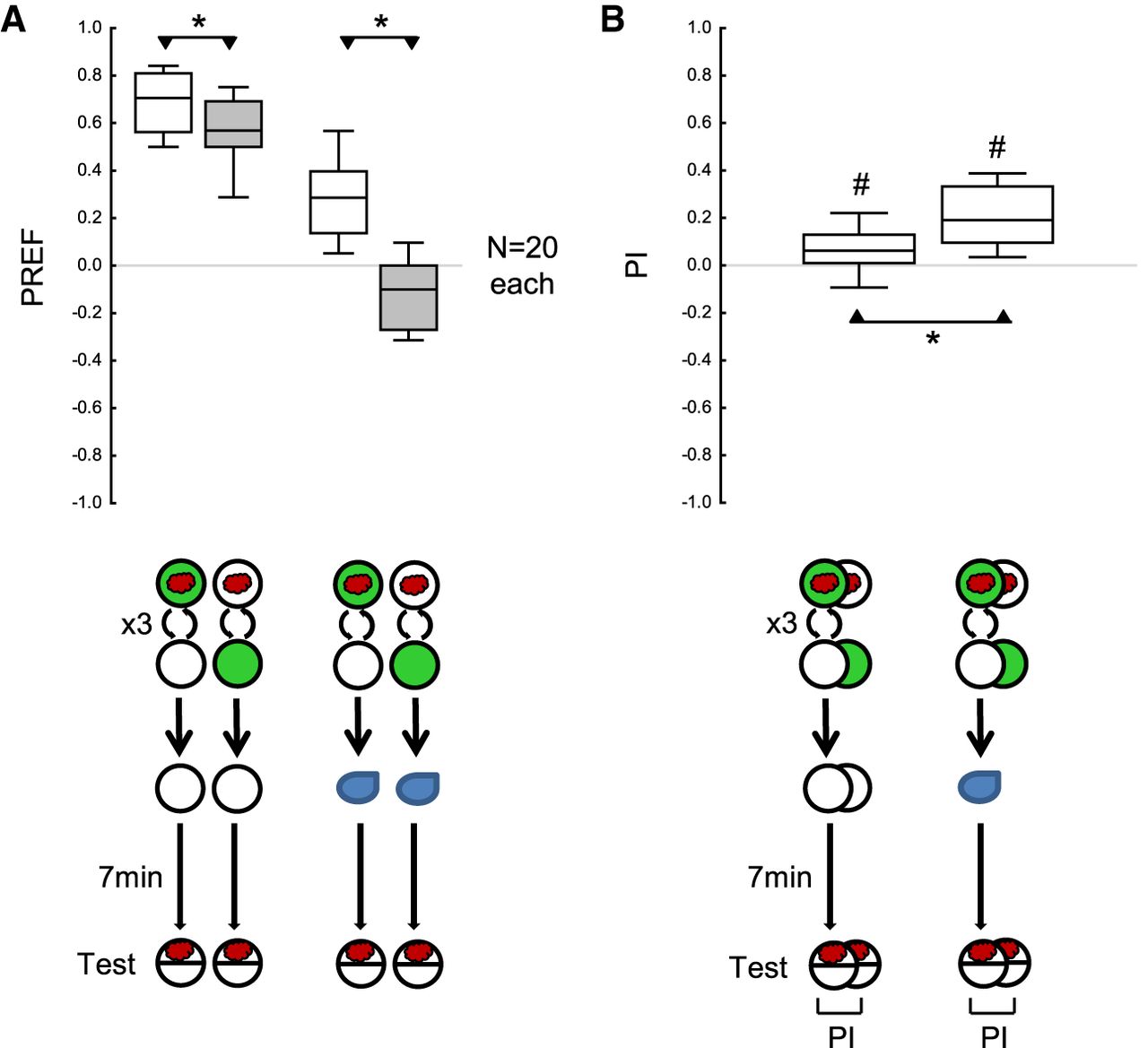
The context of the waiting period influences the detectability of memory for the first training phase. The larvae were trained and tested as in Figure 3, with a further experimental group for which the context during the waiting period between training and testing was implemented in a different way. (A,B) The larvae received three cycles of either paired odor–reward training or unpaired presentations of the odor and the reward, followed by a 7 min waiting period and then a test for their odor preference, which for these animals is their first test (Test). The groups differed according to how the waiting period was implemented. The larvae were either put in a Petri dish with an agarose substrate (left plots; this corresponds to the procedures used in Figures 1–3) or in a water droplet on a Petri dish lid (right plots). For either implementation of the waiting period, appetitive associative memory was revealed both by higher odor preferences in the paired than in the unpaired group (A) and by significantly positive PI (B). Critically, a comparison of the PI scores revealed stronger memory when the animals were kept in the water droplet (B). Sample sizes are given within the figure. * refers to MWU comparisons between groups, # refers to OSS comparisons to chance levels, that is, to zero (*,#P < 0.05 corrected according to Bonferroni-Holm). Other details as in Figures 1–3.