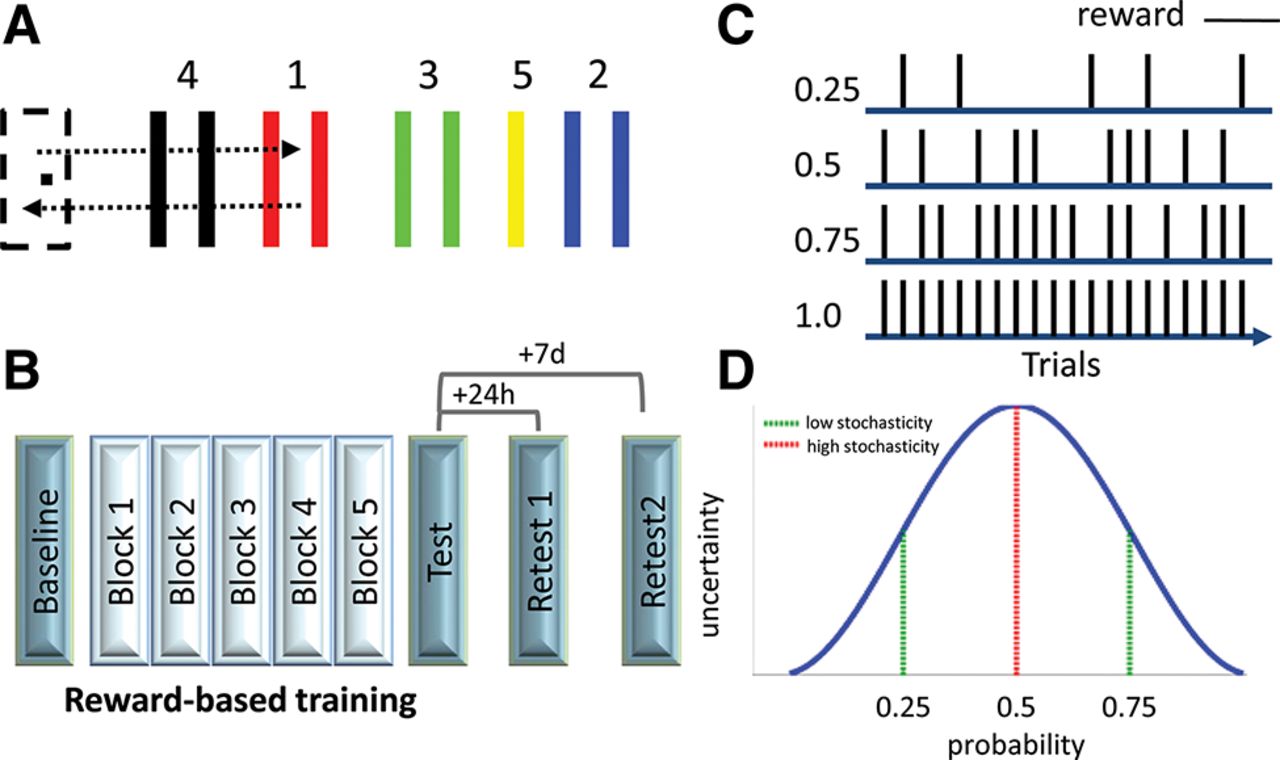
Task and design. (A) By varying the magnitude of pinch-force applied onto a force transducer, subjects moved a cursor back and forth via five numbered targets within a fixed period of time. (B) Experimental design. The experiment comprised three sessions, including a training session with reward feedback, followed by three tests of skill. (C) Reinforcement schedules. Four reinforcement schedules were tested, with reward feedback provided on 25%, 50%, 75%, or 100% of successful trials. (D) Reward uncertainty. Stochastic reinforcement was maximal and was associated with maximal levels of outcome uncertainty when reward probability was 0.5. With probabilities of 0.25 and 0.75, stochasticity and uncertainty were lower since the learning agents were operating with greater certainty pertaining to lower and higher chances of being rewarded, respectively.