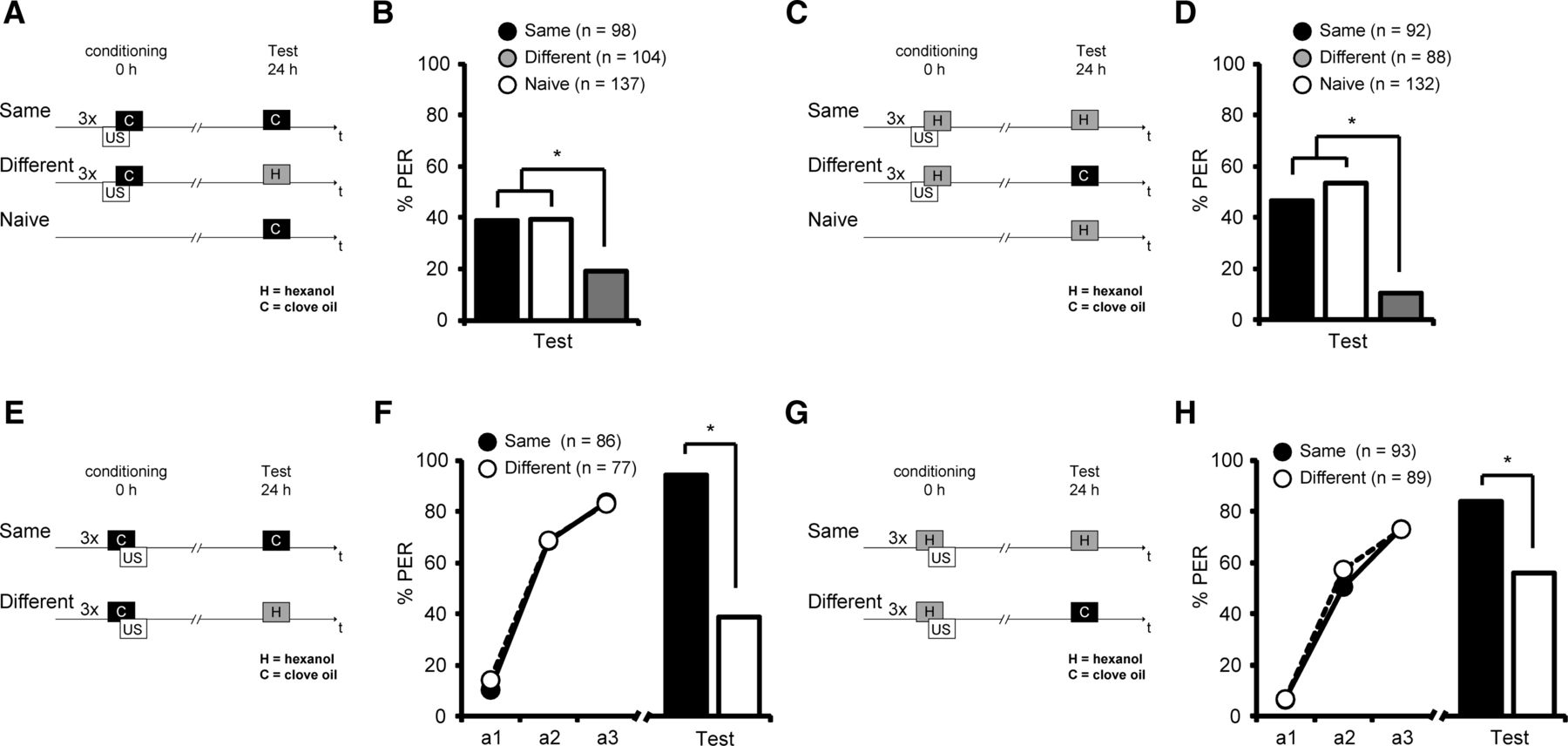
Enhanced, but generalized odor response 24 h after backward conditioning. (A–D) Schematic overview and results of the experiments investigating odor specificity of memory retention 24 h after backward conditioning with clove oil (C) or 1-hexanol (H). (B,D) Honeybees were either backward conditioned (BWISI2) or were left untreated (Naive). Twenty-four hours later the backward trained group was subdivided into two subgroups: One was tested with the same odor as in the backward conditioning (Same, black), one group was tested with a different odor as in the backward conditioning (Different, gray). In parallel, the odor responses of untreated animals were tested (Naive, white). (*) P < 0.001. (E,H) Schematic overview and results of the experiments investigating odor specificity of memory retention after backward conditioning clove oil (E,F) or 1-hexanol (G,H). (F,H) Honeybees were conditioned with three forward conditioning trials (circles). Twenty-four hours later bees where tested (bars) either with the trained odor (black) or with a different odor (white). (*) P < 0.05.