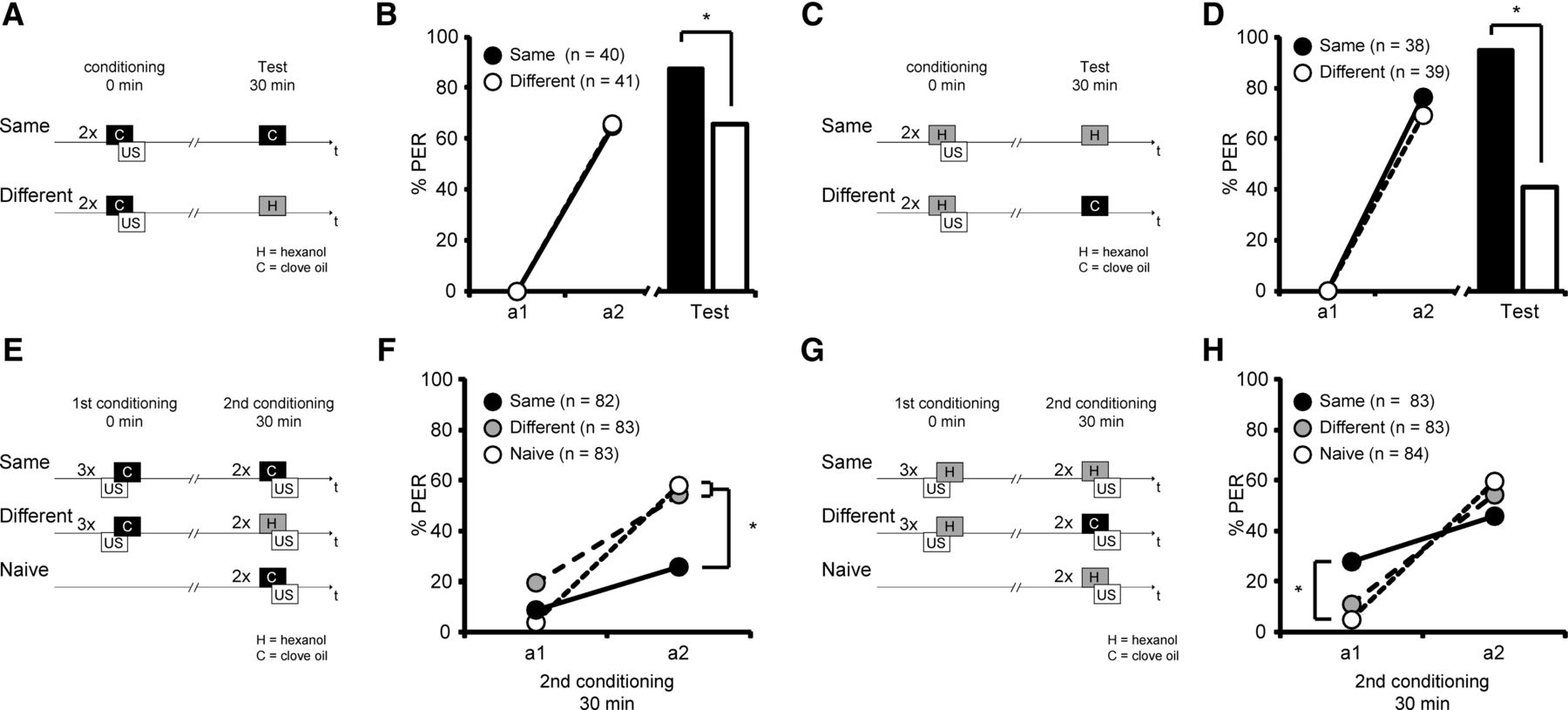
The retardation of acquisition is odor-specific. (A–D) Schematic overview and the results of the experiments investigating odor specificity of memory retention after forward conditioning with clove oil (A,B) or 1-hexanol (C,D). (B,D) Honeybees were conditioned with two forward conditioning trials (circles, first acquisition trial a1 and second acquisition trial a2). Thirty minutes later bees where tested (bars) either with the trained odor (black) or with a different odor (white). (*) P < 0.05. (E–G) Schematic overview and results of the experiments investigating odor specificity of memory retention after backward conditioning with clove oil (E,F) or 1-hexanol (G,H). (F,H) Bees were treated with three backward conditioning trials or were kept untreated. Thirty minutes later the backward trained group was subdivided into two subgroups: One was forward trained with the same odor as in the backward conditioning (Same, black), one group was forward trained with a different odor as in the backward conditioning (Different, gray). The untreated animals were also conditioned with two forward trials (Naive, white). (*) P < 0.05.