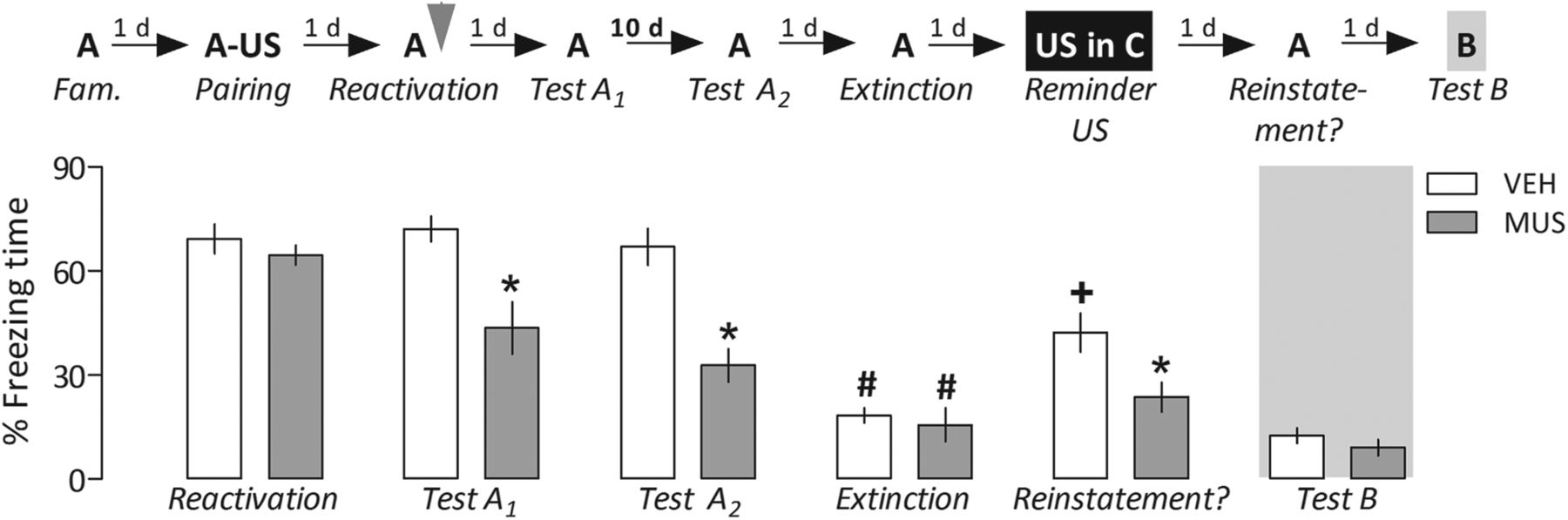
Lack of evidence for reinstatement of the fear memory after prelimbic (PL) cortex inactivation-induced reconsolidation blockade. After a familiarization (Fam.) session, animals had Context A paired with foot shocks, the unconditioned stimulus (US). On the next day, they were reexposed to Context A to retrieve/reactivate the established fear memory, and then received vehicle (VEH) or muscimol (MUS, 4.0 nmol in 0.2 µL), bilaterally infused into the PL cortex. In comparison with controls, MUS-treated animals froze less when reexposed to the paired Context A either 1 d (Test A1) or 10 d (Test A2) later, indicating that the disrupting effect of the drug was long-lasting. Both groups were subjected, 24 h later, to extinction of fear memory in the paired Context A for 15 min. On the next day, animals were exposed to Context C for 1 min where they received a single lower-intensity reminder foot shock (US). Twenty-four hours later, they were tested for memory reinstatement by being reexposed to the conditioned Context A for 5 min. During this session, controls showed a higher freezing time than PL cortex-inactivated animals. Both groups, however, behaved similarly in the neutral Context B (Test B). The gray arrowhead indicates the moment of drug treatment. Bars represent the percentage of total freezing time. Values are expressed as mean ± SEM. (*) Significant difference (P < 0.05) compared with the respective controls, (#) significant difference from the same group during Test A2, (+) significant difference from the same group during extinction (repeated-measures ANOVA followed by Newman–Keuls test).