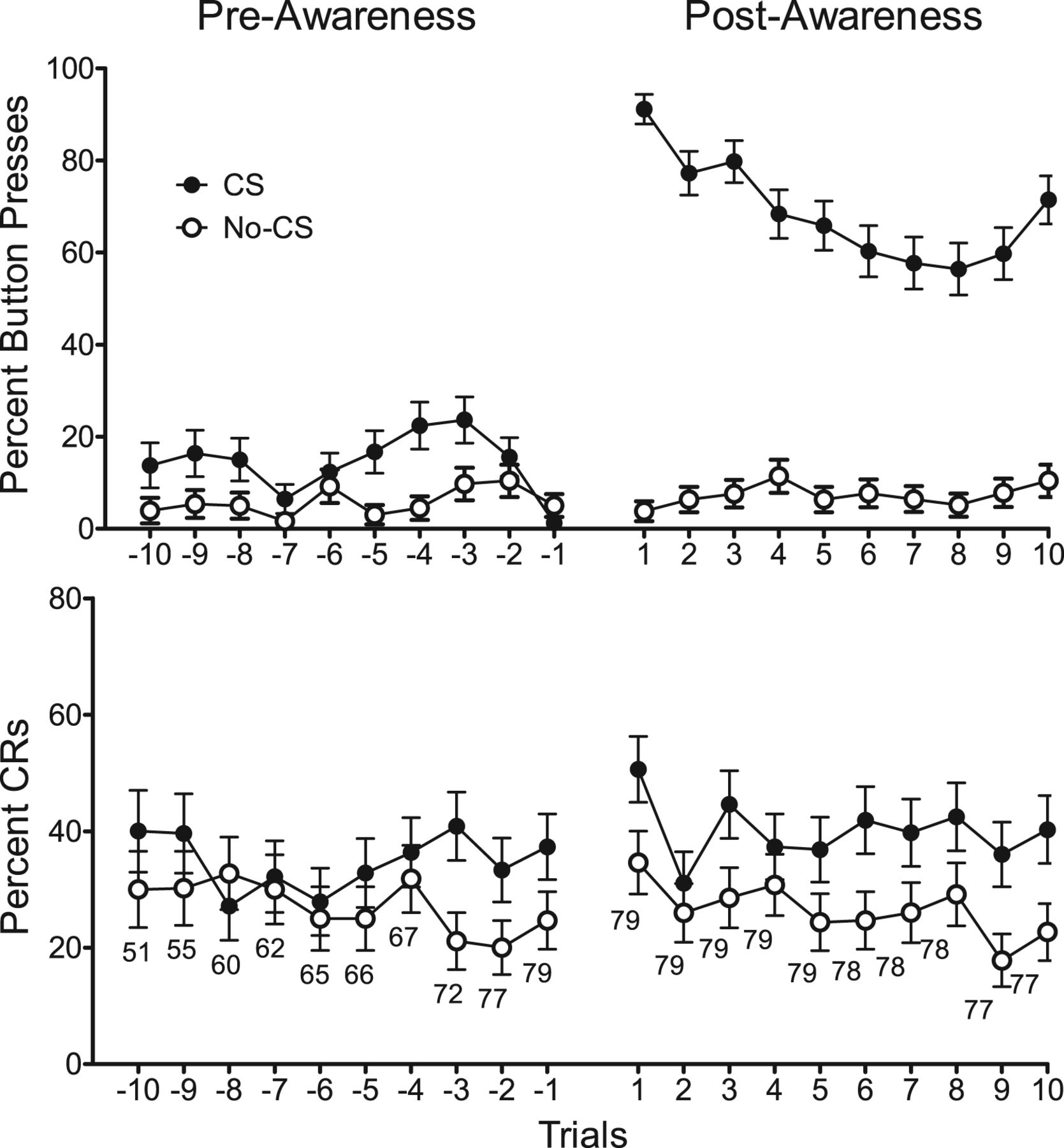
Mean percentage of US-expectancy button presses (upper panels) and eyeblink CRs (lower panels) made on CS and No-CS trials as a function of the development of CS–US contingency awareness. Data are shown for the 10 trials preceding and following the point of awareness (trial +1), defined for each individual according to change-point analysis (Taylor 2000). This analysis, which uses a combination of cumulative sum charts and bootstrapping to detect a point of inflection, was applied to button-press responding on successive blocks of two CS and two No-CS trials. The first block during which there was a significant increase in this difference score, according to the change-point analysis, was determined to be the block when awareness developed for that participant. The numbers in the bottom panel next to each trial indicate the number of participants who contributed data on that trial (participants who became aware early may have had fewer than 10 pre-aware trials, whereas participants who became aware late may have had fewer than 10 post-aware trials).