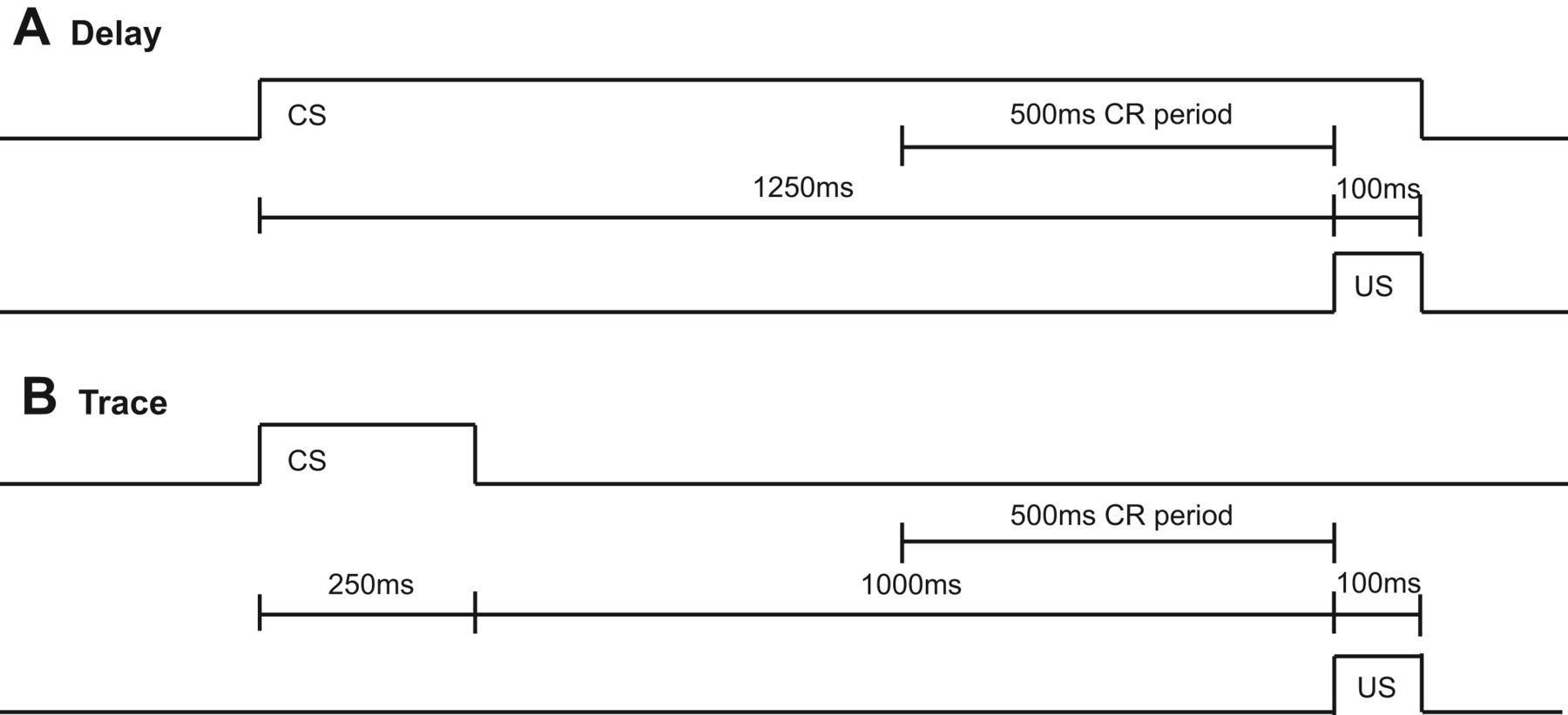
Temporal parameters used for conditioning. (A) In the Delay group, the CS was presented for 1350 msec, overlapping and coterminating with the 100-msec US. (B) In the Trace group, the CS was presented for 250 msec, followed by a 1000-msec trace interval, followed by the 100-msec US. The inter-stimulus interval was therefore 1250 msec for both groups. Each trial was separated from the next with an inter-trial interval (ITI) of 10–15 sec. An eyeblink was scored as a CR if it occurred in the 500-msec time interval before onset of the US, or in the equivalent period on blank trials. In addition, the amplitude of the blink had to be at least 20% of that participant’s unconditioned blink amplitude in response to the first five US presentations of the conditioning session.