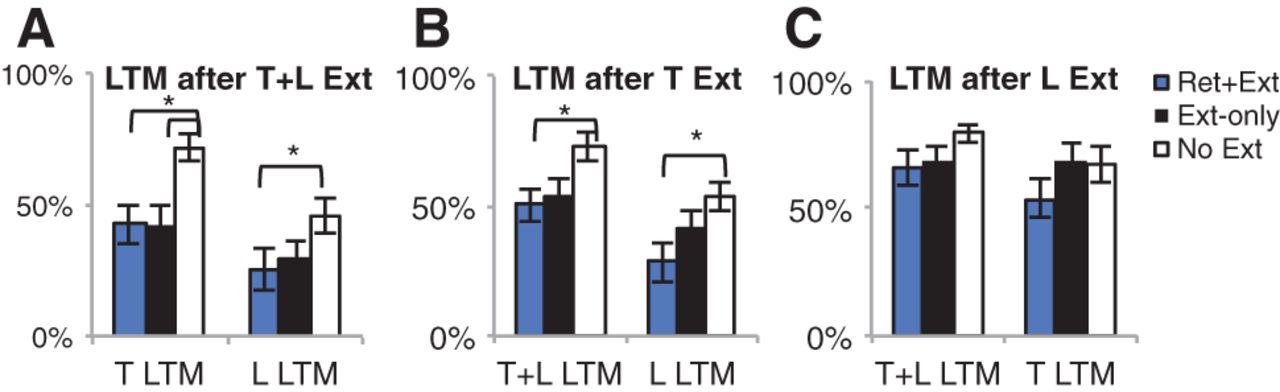
Freezing during LTM tests to the cues that were not the same as the cue extinguished in experiment 3. (A) Retrieval+extinction (n = 12) as well as extinction only (n = 12) of the full T+L compound resulted in a significant decrease in freezing to the tone component compared to the no ext group (n = 12) (ret+ext, P = 0.007; ext-only, P = 0.009). Additionally, retrieval+extinction of the full T+L compound (n = 12) resulted in significant reductions in freezing to the light compared to the no ext group (n = 12; T+L, P = 0.045), whereas the extinction-only group (n = 12) did not quite reach significance (P = 0.135). (B) Freezing during LTM to T+L showed that retrieval+extinction of the tone (n = 12) resulted in a significant decrease in freezing compared to the control group (n = 12) during T+L LTM (P = 0.040), whereas the tone extinction only (n = 12) did not result in a significant reduction in freezing during T+L LTM (P = 0.122). Retext of the tone component (n = 12) resulted in reduced freezing to the light during light LTM tests (P = 0.005). Post-hoc Tukey HSD mean comparison tests showed that retrieval+extinction of the tone component resulted in significant reductions in freezing to the light compared to the no ext group (n = 12, P = 0.005), whereas the ext-only group did not reach significance (n = 12, P = 0.169). (C) Extinction of the light component did not result in any significant decreases in freezing for either the ret+ext (n = 12) or the ext-only (n = 12) group during T+L LTM (P = 0.088 and P = 0.185, respectively). Post-hoc Tukey HSD mean comparison tests showed that neither ret+ext (n = 12) nor extinction only of the light (n = 12) resulted in significant reduction in freezing to the tone component (ret+ext, P = 0.253; ext-only, P = 0.985). Error bars represent ± SEM. (*) P < 0.05.