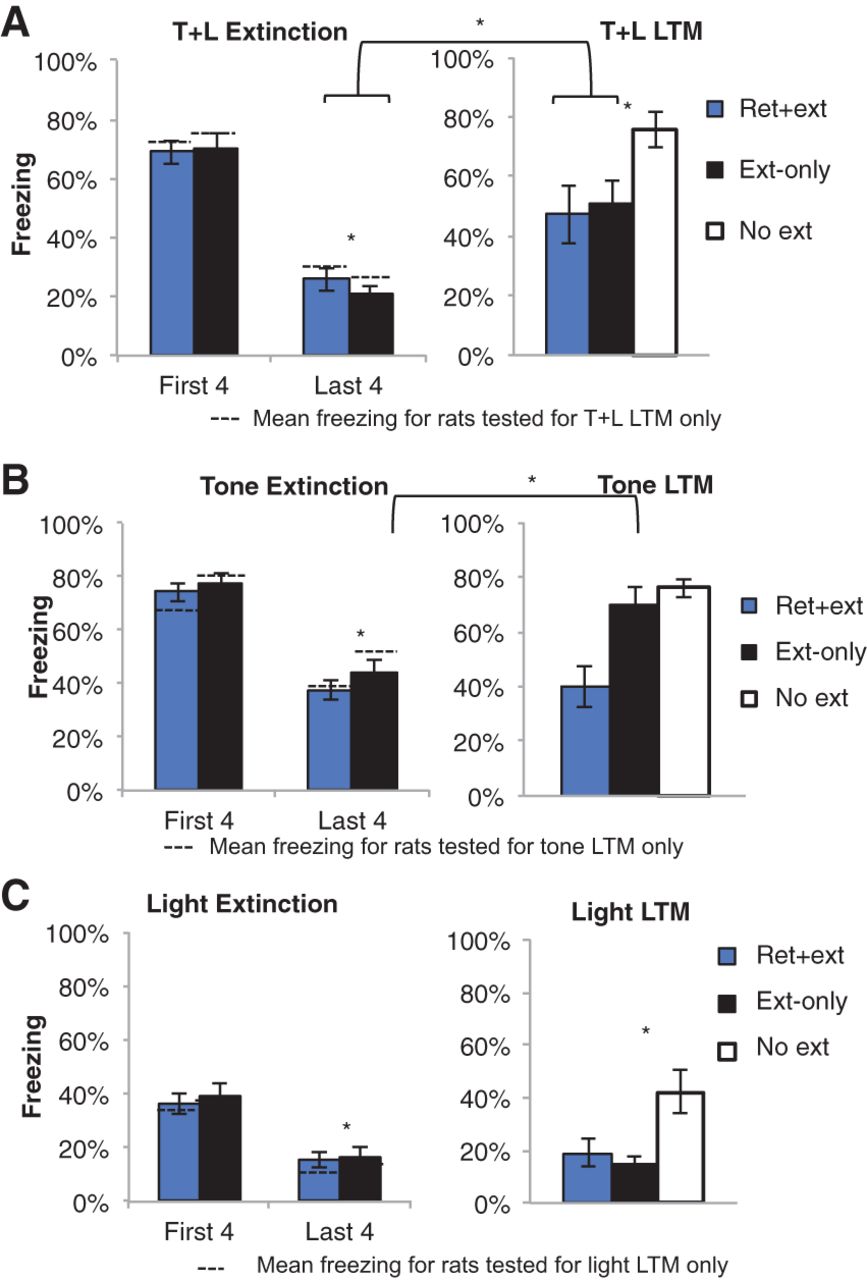
Freezing during the first four and last four trials of extinction after either an isolated retrieval session of context-only retrieval followed by 10 min in the home cage, along with LTM tests to a single component of the T+L compound after T+L fear conditioning. For each panel, the dotted lines indicate the mean freezing of the rats that were later tested for LTM of the same component as extinction. (A) Ext-only or ret+ext of the T+L compound results in a significant reduction in freezing during the extinction session (P < 0.001); however, during LTM tests 24 h after extinction, there is recovery of freezing with both extinction treatments (P < 0.001) suggesting that compound memories are resistant to extinction. Nonetheless, ret+ext of the T+L compound resulted in a significant reduction in freezing (P > 0.05) compared to the no ext group. (B) During tone extinction, both groups showed extinction to the tone component (P < 0.001). However, the ext-only group showed spontaneous recovery of freezing (P = 0.026) during LTM tests 24 h after extinction, whereas the ret+ext group maintained a reduction in freezing compared to the no ext group (P < 0.0001) and ext-only group (P = 0.002). (C) During light extinction, both groups (ret+ext and ext-only) showed extinction to the light component (P < 0.001). Additionally, neither group showed spontaneous recovery during the light LTM test (P = 0.33) and maintained a significant reduction in freezing compared to the no ext group (ret+ext, P = 0.008; ext-only, P = 0.002).