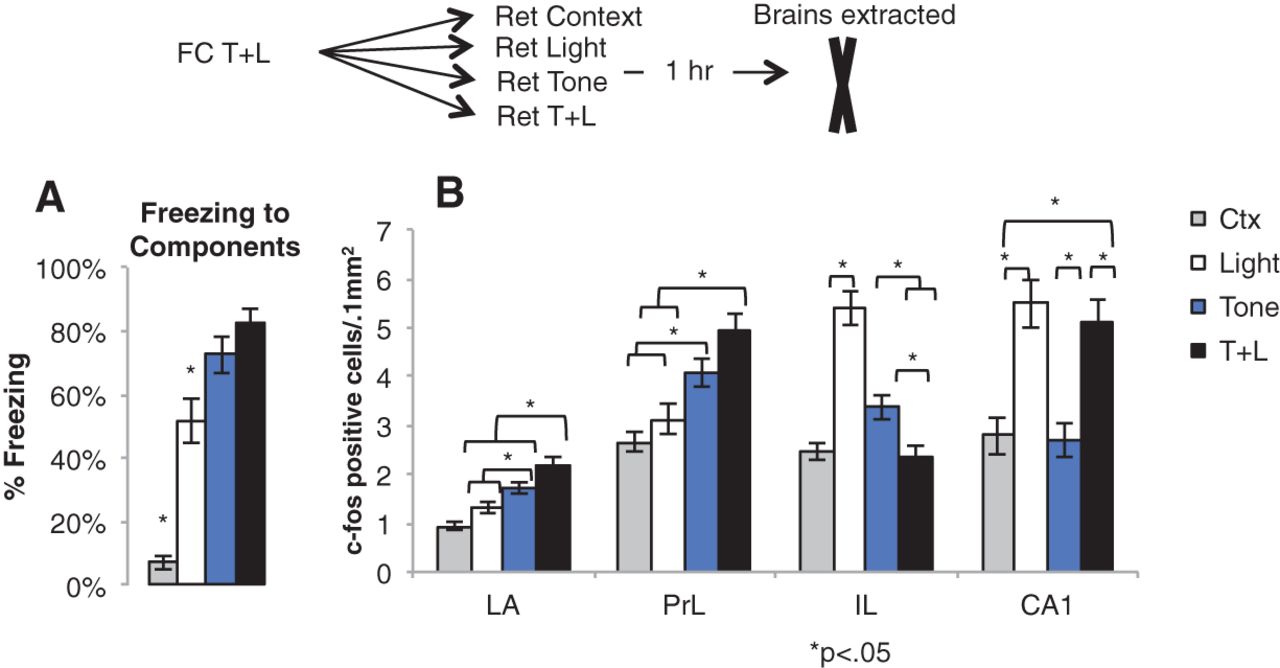
Counts of c-Fos positive cells in the LA and vmPFC (IL and PrL) after an isolated retrieval of one of the components (context, n = 5; light, n = 5; tone, n = 6; or T+L, n = 5) and freezing to each component. (A) Freezing during a single retrieval of the elements of the compound 1 h prior to perfusion. Rats froze significantly less during light retrieval than during retrieval of either the full T+L compound or retrieval of the tone (P < 0.05). Rats showed significantly less freezing during context retrieval (n = 5) when compared to retrieval of any of the elements (P < 0.001 for L [n = 8], T [n = 9], and T+L [n = 9]). Rats did not freeze significantly less to the tone than they did to the T+L during retrieval (P = 0.632). (B) c-Fos activity in the lateral amygdala mirrored the pattern of expression seen in freezing where retrieval of the T+L results in significantly more activation than that of the light (P = 0.001) and context (P < 0.001) and retrieval of the tone results in significantly more activation than that of the context (P = 0.026) but does not reach significance when compared to the light (P = 0.063). Expression in the PrL showed that retrieval of the T+L compound resulted in significantly more c-Fos activity than retrieval of the context alone (P = 0.037). The IL showed the opposite pattern of expression than that seen in the PrL, consistent with the idea that the PrL and IL have opposing functions in fear conditioning, where retrieval of the light resulted in significantly more activity than retrieval of any of the other components (P < 0.001). Additionally, retrieval of the tone resulted in significantly more c-Fos activity than retrieval of the full compound (P = 0.049) in the IL. In the CA1 subfield of the hippocampus, a region involved in contextual fear conditioning, retrieval of the light and T+L resulted in significantly more activation than retrieval of the tone (P = 0.033 and P = 0.048, respectively). Error bars represent ± SEM.