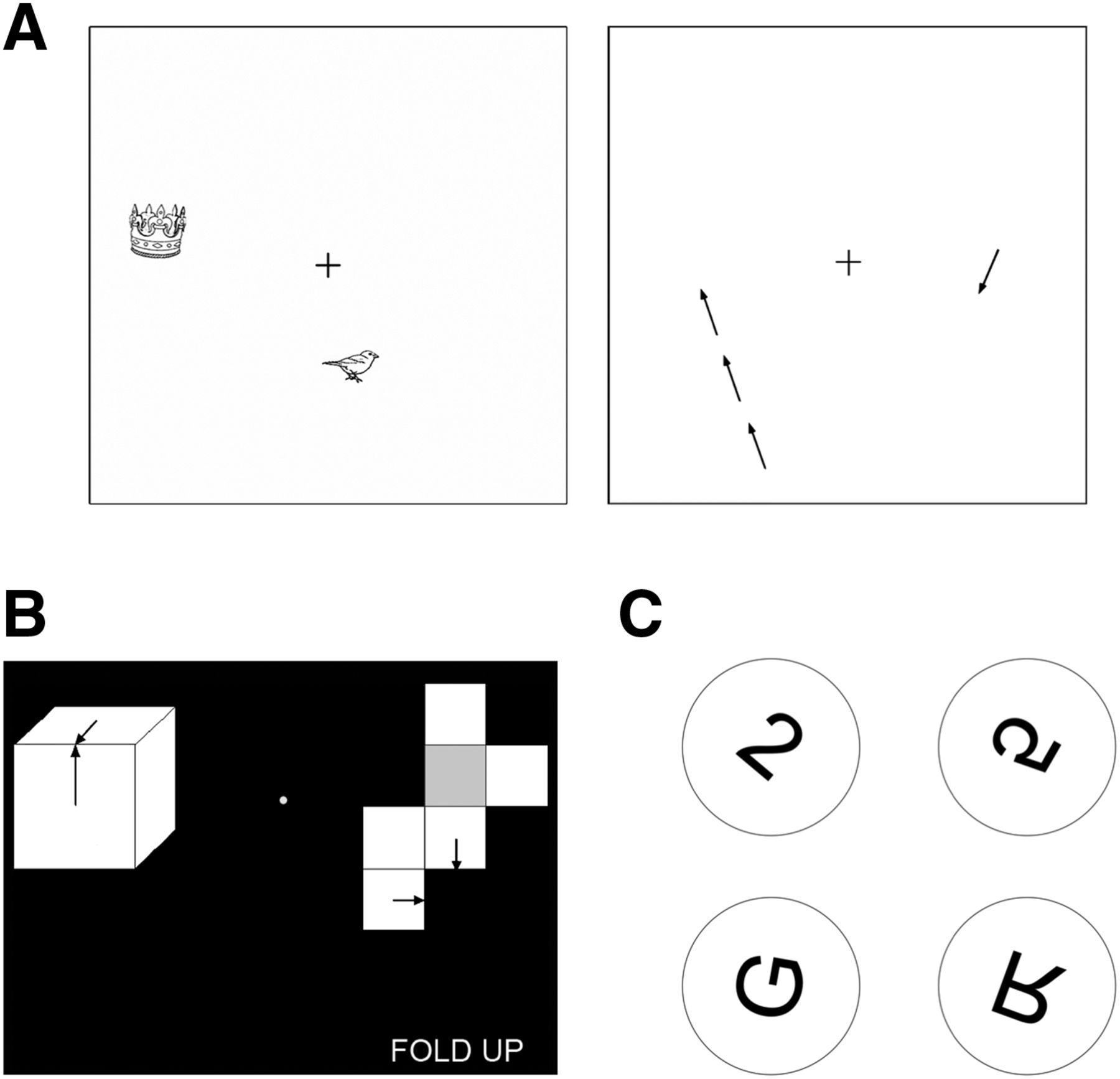
(A) Sample displays from the Imagery for Spatial Location task. (Left) On each trial, two objects were presented simultaneously for 3 sec. Participants were asked to maintain the locations of the objects in mind while fixating the cross. (Right) One second after the objects disappeared, a single arrow was displayed. The task was to determine whether or not the arrow pointed to a location previously occupied by one of the objects. When it pointed to one of these two locations, the arrow was positioned a short, medium, or long distance from the location (as shown to the left). The arrow to the right is pointing to neither of the locations previously occupied by an object. (B) A sample trial from the Mental Paper Folding task. Participants were asked to mentally fold the unfolded cube (right) and then decide, by inspecting the locations of the arrows, whether the two cubes were identical or different. A note “FOLD UP” (or “FOLD DOWN”) indicated whether the shaded box represented the bottom (or top) of the cube. There were three levels of difficulty (easy, medium, and difficult). This example illustrates a difficult trial with identical cubes. (C) Sample stimuli from the Mental Rotation task. Participants were asked to mentally rotate a character into its upright position and then determine whether the character was then normal or backward. Moving clockwise from the upper left, the examples illustrate clockwise rotations of 40°, 120°, 200°, and 280°. The 2 and G are normal, and the 5 and R are backward.