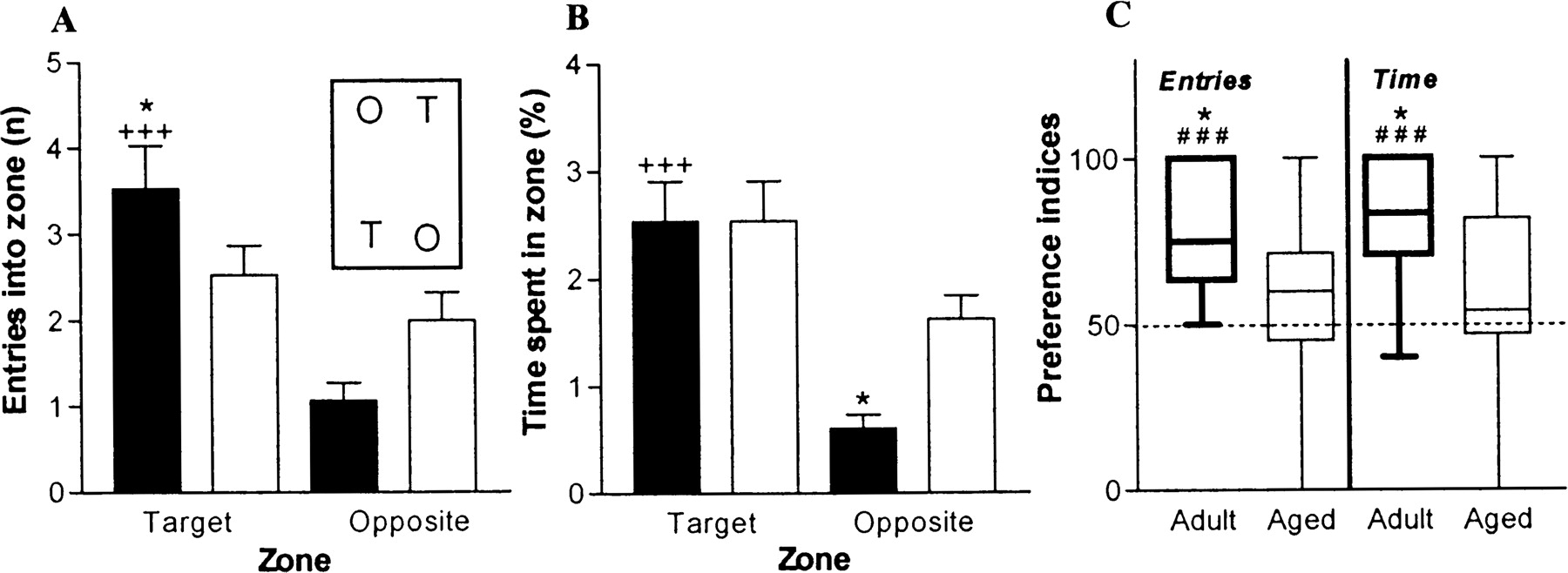
During the “geometry probe trial,” adult mice (solid bars in A,B; thick box plots in C) used geometry to find the platform, whereas aged mice (open bars in A,B; thin box plots in C) could not orientate themselves on the basis of this sole information. (A, inset) A scheme of the maze. (T) Target zones, (O) opposite zones (incorrect). Entries into and time spent in the target and opposite zones were obtained by adding up values of the two target zones and the two opposite zones for each mouse. Number of entries into and time spent in zones are represented with means plus S.E.M. The preference indices are shown with standard box plots. +++P < 0.001, difference between the target zone and the opposite zones within the adult group (Newman-Keuls post hoc after a significant effect of zone); (A,B) *P < 0.05, as compared with the aged group within the same zone (Newman-Keuls post hoc after a significant effect of the interaction between group and zone); (C) *P < 0.05 as compared with the aged group (Mann Whitney U-test); ###P < 0.001, as compared with chance level (50%) (Wilcoxon signed-rank test).