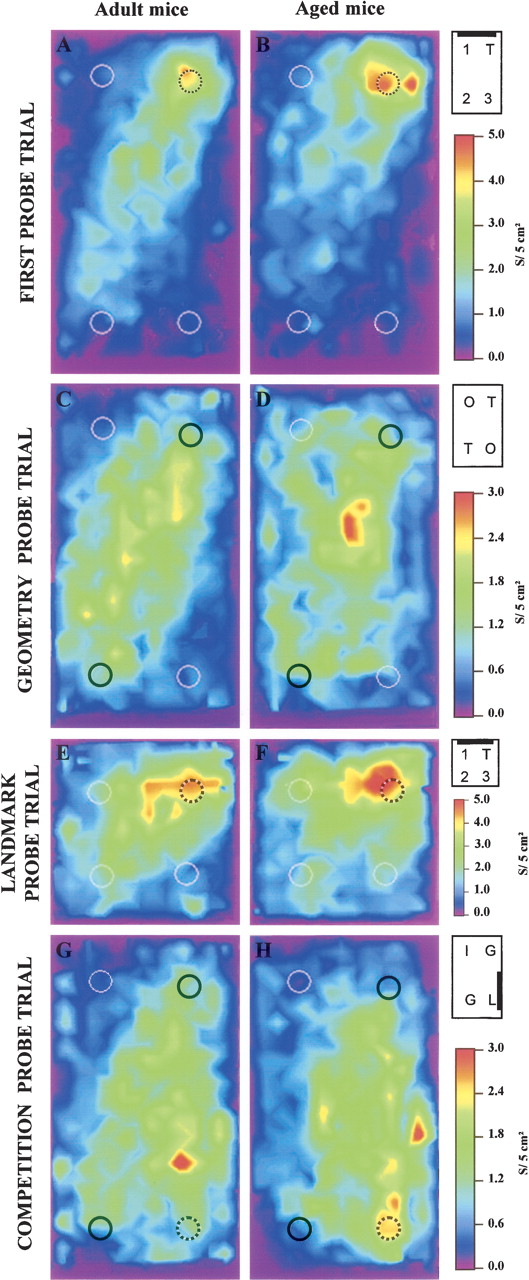
Spatial histograms of the mouse locations during the probe trials. Schemes of the maze and rainbow scales are shown on the right side for each probe trial. (A,C,E,G) Adult group; (B,D,F,H) aged group. (A,B) “First probe trial.” The target is depicted with a thin dotted circle on the histograms and “T” in the corresponding scheme. (C,D) “Geometry probe trial.” The two target zones are depicted with black line circles on histogram and “T” in the corresponding scheme. (E,F) “Landmark probe trial.” The target location is depicted with a thick dotted circle and “T” in the corresponding scheme. (A–F) The other zones (incorrect) are depicted with a thin white circle on the histograms and “O”, “1”, “2,” and “3” in the corresponding schemes. (G,H) “Competition probe trial.” Geometry zones (black line circles, histogram; “G” in the corresponding scheme); landmark zone (thick dotted circle, histogram; “L” in the corresponding scheme); incorrect zone (thin white circle, histogram; “I” in the corresponding scheme).