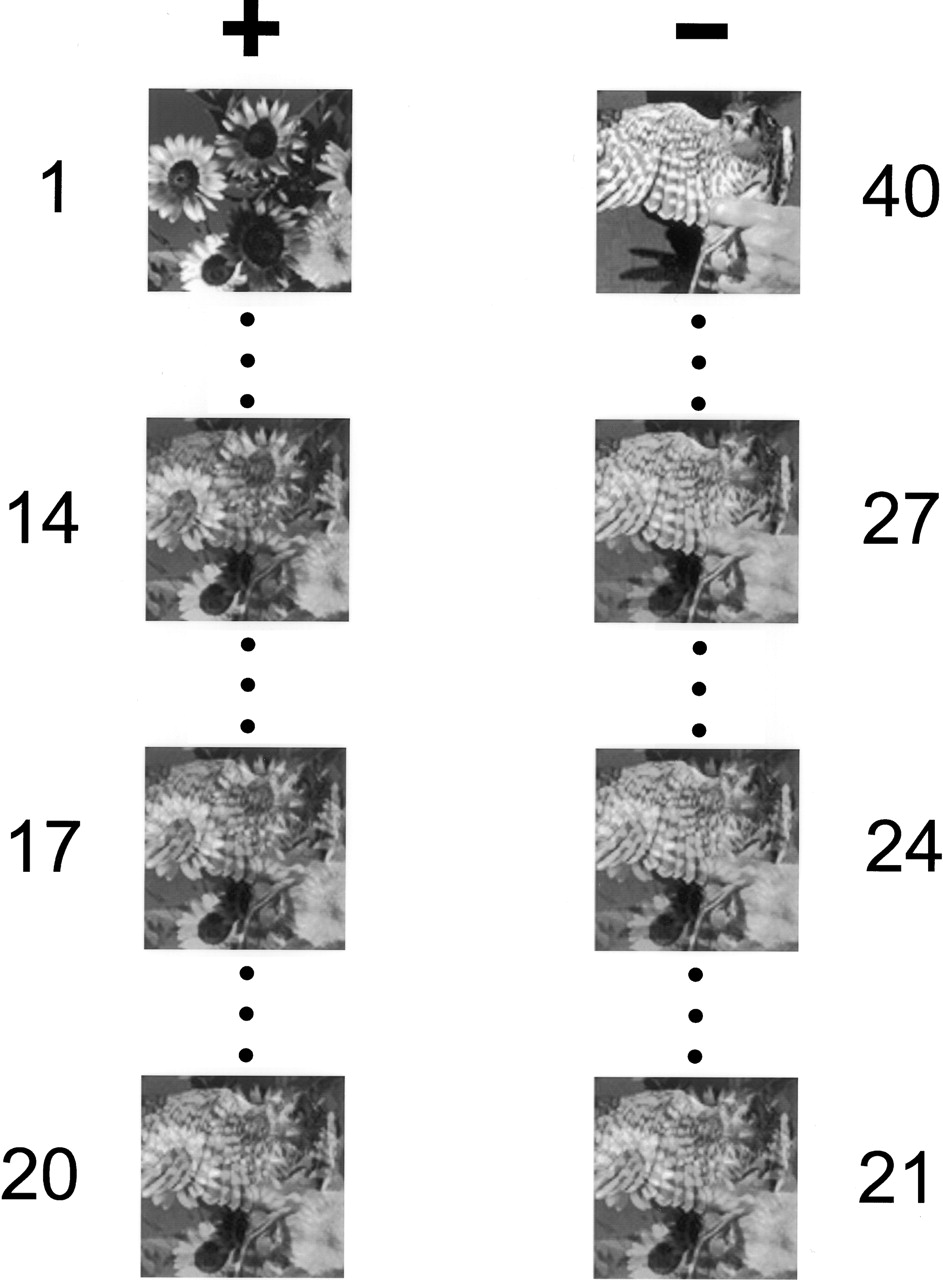
Example of grayscale picture stimuli used in Bussey et al. (2003). To create each pair of stimuli, two pictures were “morphed” (blended) together to create a series of 40 images, the first images in this series consisting mostly of features from picture 1, the latter images consisting mostly of features from picture 2. The numbers next to an image indicate the position of the image in the series. In the experiment described here (Experiment 2), the original images, numbers 1 and 40, were used as the low feature ambiguity “trained pair,” images 14 and 27 were chosen to be the high feature ambiguity “pair 1,” and images 17 and 24 were chosen to be the high feature ambiguity “pair 2.” The + and − indicate that the images on the left, in this example those most similar to the photograph of the sunflowers, were the correct (rewarded) images in the pair, whereas those on the right were incorrect (unrewarded), respectively.