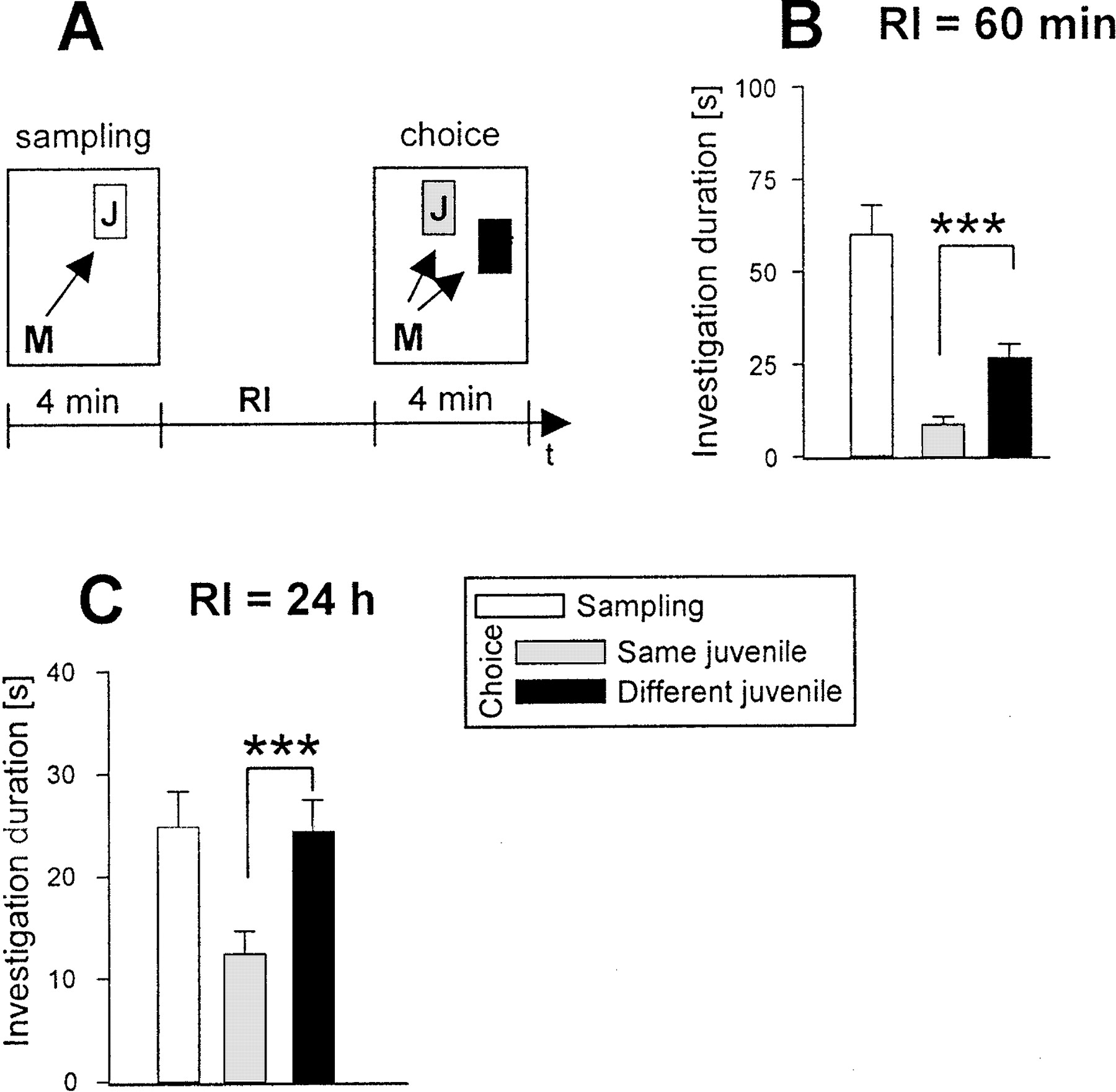
Olfactory recognition memory performance as a function of the retention interval (RI) of adult male mice was tested in the social discrimination procedure. (A) The principle of the social discrimination test. A conspecific juvenile (letter “J” in white box) is exposed to an adult male mouse (A) during a 4-min sampling period. This juvenile is removed and after a given RI it is re-exposed during the choice session (“J” in gray box) but this time together with a different, nonfamiliar juvenile (“J” in black box). The duration taken by the adult to investigate the juvenile(s) (represented by arrows) is measured by a trained observer and expressed separately for each juvenile as the “investigation duration.” At RIs of 60 (B) and 24 h (C), during “choice”, mice are able to discriminate a juvenile exposed earlier (during sampling, “same juvenile”) from a different juvenile (left panels). *P < 0.05, ***P < 0.001, paired Student's t-test.